

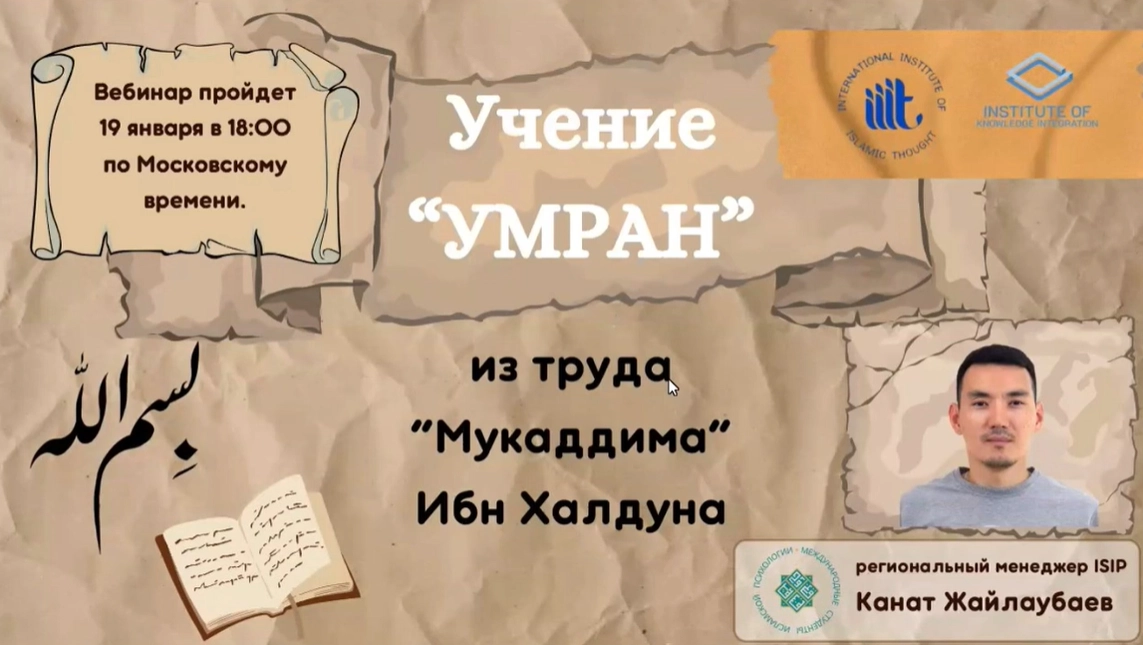
As part of the IIIT Lectures Series for CIS Countries, a webinar was held on January 19 titled “An Overview of the Concept of ‘Umran’ from Ibn Khaldun’s Muqaddimah,” delivered by Kanat Zhailaubayev.
Kanat Zhailaubayev is the Head of the Regional Office of the International Association of Islamic Psychology (ISIP) for the CIS countries.
The webinar presented the life and legacy of Ibn Khaldun — the renowned 14th-century historian, philosopher, and thinker of the Islamic tradition, widely recognized as the father of sociology and historiography. The speaker provided an in-depth analysis of the historical context in which Ibn Khaldun lived — a time marked by intense political instability and internal conflicts that plagued much of the Muslim world.
A detailed examination was given of Ibn Khaldun’s key concept of ʿUmrān, which seeks to explain the social, political, and cultural dynamics of human society. The speaker explained foundational ideas such as ʿasabiyyah (social cohesion or group solidarity) and ʿumrān (civilization), and how they contribute to the rise and fall of states and civilizations.
The cyclical nature of political entities and social structures was also discussed, outlining stages of emergence, flourishing, decline, and collapse. Attention was drawn to the role of climate, geography, and culture in shaping peoples and states. The lecture also touched on the impact of Sufism, philosophy, and various religious schools on historical processes.
The speaker highlighted Ibn Khaldun’s influence on the development of scholarly traditions in Turkey and the post-Soviet space, noting that his work offers valuable methodological and philosophical tools for understanding contemporary social phenomena, historical cycles, and civilizational shifts.
Additionally, the lecture noted how many modern researchers and psychologists are drawing on Ibn Khaldun’s insights to integrate traditional Islamic knowledge with the social sciences in the context of modernity. The speaker stressed the enduring relevance of Ibn Khaldun’s thought for analyzing current social, cultural, and political processes.
This webinar would be of interest to scholars, researchers, and students, as well as anyone interested in classical Islamic thinkers and their intellectual contributions.