

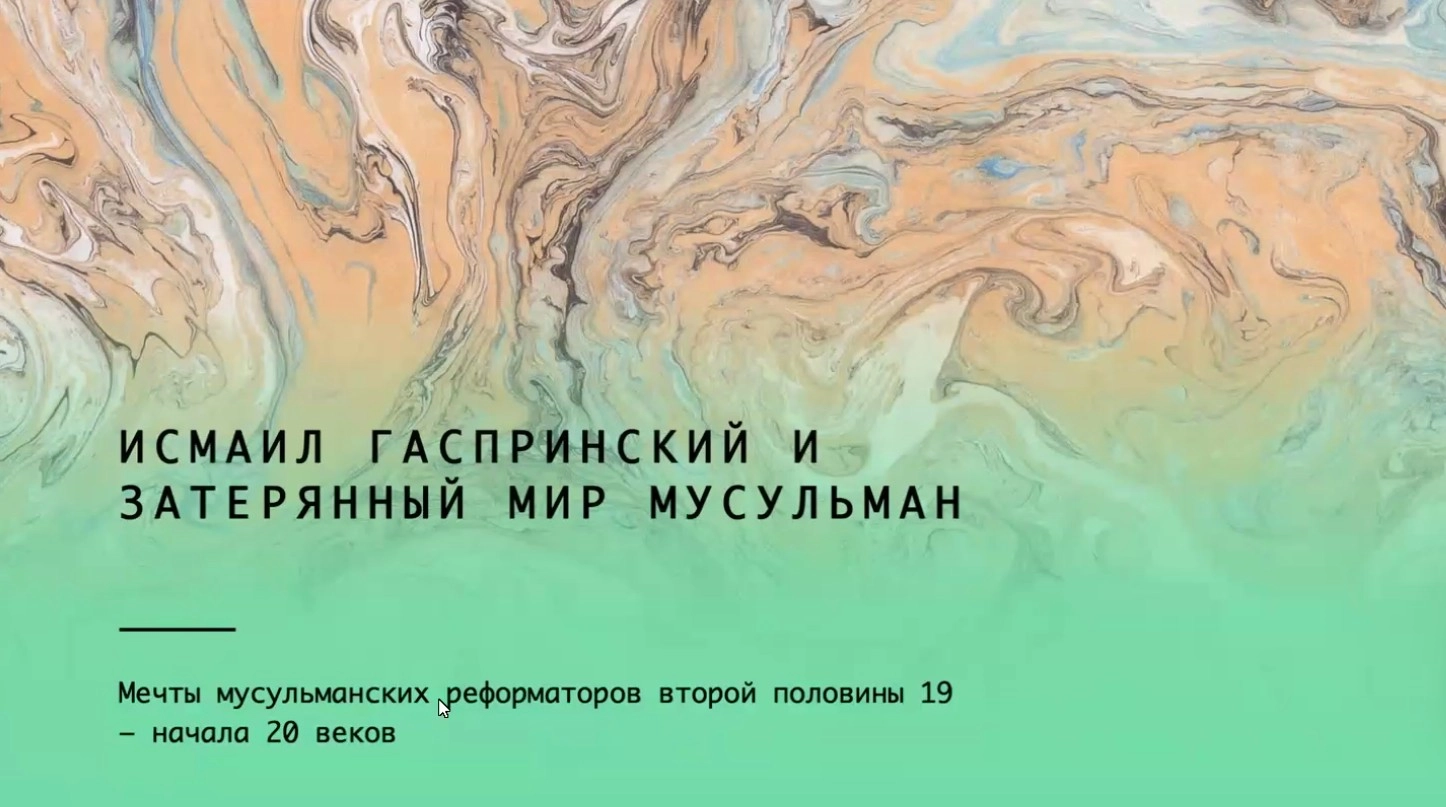
As part of the IIIT Lectures Series for CIS Countries, a webinar was held on August 31, 2025, titled “Ismail Gasprinsky and the Lost World of Muslims,” delivered by Svitlana Kayuk.
Svitlana Kayuk holds a PhD in History and is an Associate Professor in the Department of Ukrainian History at Oles Honchar Dnipro National University. She is a researcher of Crimean history, Crimean Tatar culture, Jadidism, and educational reform movements in Muslim societies.
The lecture was devoted to the intellectual legacy of the Crimean Tatar educator, writer, and reformer Ismail Gasprinsky, the founder of Jadidism. During the event, the following issues were discussed:
• The significance of literary genres in shaping historical and cultural images, illustrated through Gasprinsky’s novel French Letters.The challenge of searching for and reconstructing the “lost world of Muslims” — a unique civilizational reality perceived through the lens of modernity and the colonial era.
• Gasprinsky’s key ideas as a writer, an educational reformer, and the publisher of the newspaper Tercüman.
The speaker examined in detail Gasprinsky’s biography and his social and cultural trajectory. Special attention was given to the following aspects:
– His origins in a Crimean Tatar family of noble lineage, the specific features of nobility in the Russian Empire, and the influence of his family on the formation of his personality.
– The European (particularly Parisian) stage of his life and its significance for his self-identification and for broadening his intellectual horizons.
– The direct assimilation of European ideas without relying on Russian intellectual intermediaries.
Analysis of the novel French Letters and the “lost world” genre.
A central part of the lecture was devoted to Gasprinsky’s novel French Letters, presented as an example of adventure and utopian literature. A detailed comparative analysis was conducted between the novel and works by late 19th-century English and French authors such as Haggard, Conan Doyle, and Jules Verne.
The speaker emphasized that Gasprinsky stands as one of the pioneers of the “lost world” genre within a Muslim cultural context. The protagonist of the novel (Malaabas) undergoes a journey of “search” between East and West, symbolizing the intellectual and cultural path of a Muslim entering the age of modernity.
It was noted that the “lost world” in Gasprinsky’s novel differs from its Western counterparts: it is rooted not solely in a colonial or exploratory impulse, but also in an attempt to reflect on a distinct Muslim utopia — on the goals of education, modernization, and the preservation of Muslim identity.
Svetlana Kayuk highlighted the uniqueness of Gasprinsky as an author who unites Eastern European, Ottoman, and Muslim cultural layers. She emphasized the relevance of revisiting literary and intellectual explorations of the 19th and early 20th centuries to better understand the trajectories of development for contemporary Muslim societies.
The webinar demonstrated that studying Gasprinsky provides a new perspective on the history of the “lost world of Muslims,” on the colonial experience, on the intersection of European and Muslim modernities, and on broader issues of cultural memory and self-identity.