

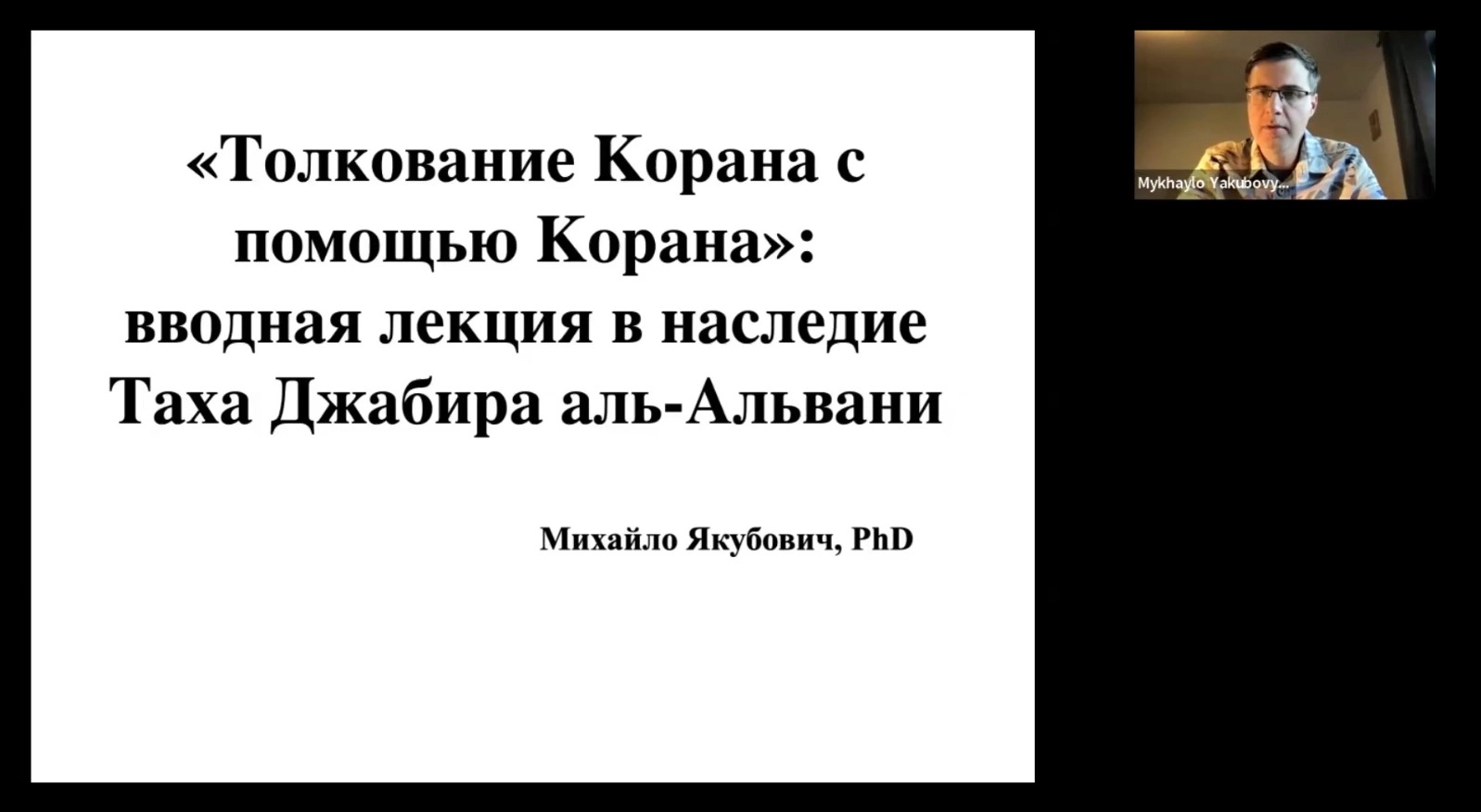
As part of the IIIT Lectures Series for CIS Countries, a webinar was held on April 20, 2025, titled “Interpreting the Qur’an Through the Qur’an,” an introductory lecture on the legacy of Taha Jabir Al-Alwani. The lecture was delivered by Mykhaylo Yakubovych.
Mykhaylo Yakubovych holds a PhD in History and is a Ukrainian Orientalist, translator, and researcher of doctrinal and philosophical thought in the Islamic world. From 2016 to 2019, he headed the Center for Islamic Studies at the National University of Ostroh Academy, and since 2020 he has served as a lecturer at the University of Freiburg (Germany). He is the author of the first complete translation of the meanings of the Qur’an into Ukrainian directly from Arabic.
The lecture was dedicated to one of the most prominent Islamic thinkers of the 20th and 21st centuries — Taha Jabir al-Alwani (1935–2014), co-founder of the International Institute of Islamic Thought and creator of a unique methodology for Qur’anic interpretation. It examined al-Alwani’s approach to tafsīr, based on the principle of “interpreting the Qur’an through the Qur’an” — that is, uncovering the deep interconnections between different verses (āyāt) to enhance textual understanding.
The discussion addressed the relevance of contemporary tafsīr in an era marked by a multitude of Qur’anic commentaries and translations. Al-Alwani’s methodology relies on reason, contextual analysis, and historical awareness, rather than on a strictly literal reading of verses and chapters. It was emphasized that tafsīr is not an exhaustive or final explanation of the Qur’an, but a process that remains open to continuous reflection and adaptation to modern realities.
A detailed analysis of al-Alwani’s key work Tafsīr al-Qur’ān bi-l-Qur’ān was presented, with examples and explanations of specific verses. The speaker clarified that the Qur’an contains multiple levels of meaning — both literal and allegorical (muḥkamāt and mutashābihāt). The importance of maintaining a balance between tradition and modernity, as well as between literal and figurative interpretation, was highlighted.
This lecture offered a fresh perspective on Qur’anic studies, emphasizing the need for a contextual and systematic approach to tafsīr. It demonstrated how a modern Islamic thinker and his intellectual school address the challenges of modernity while remaining rooted in the classical theological tradition.