

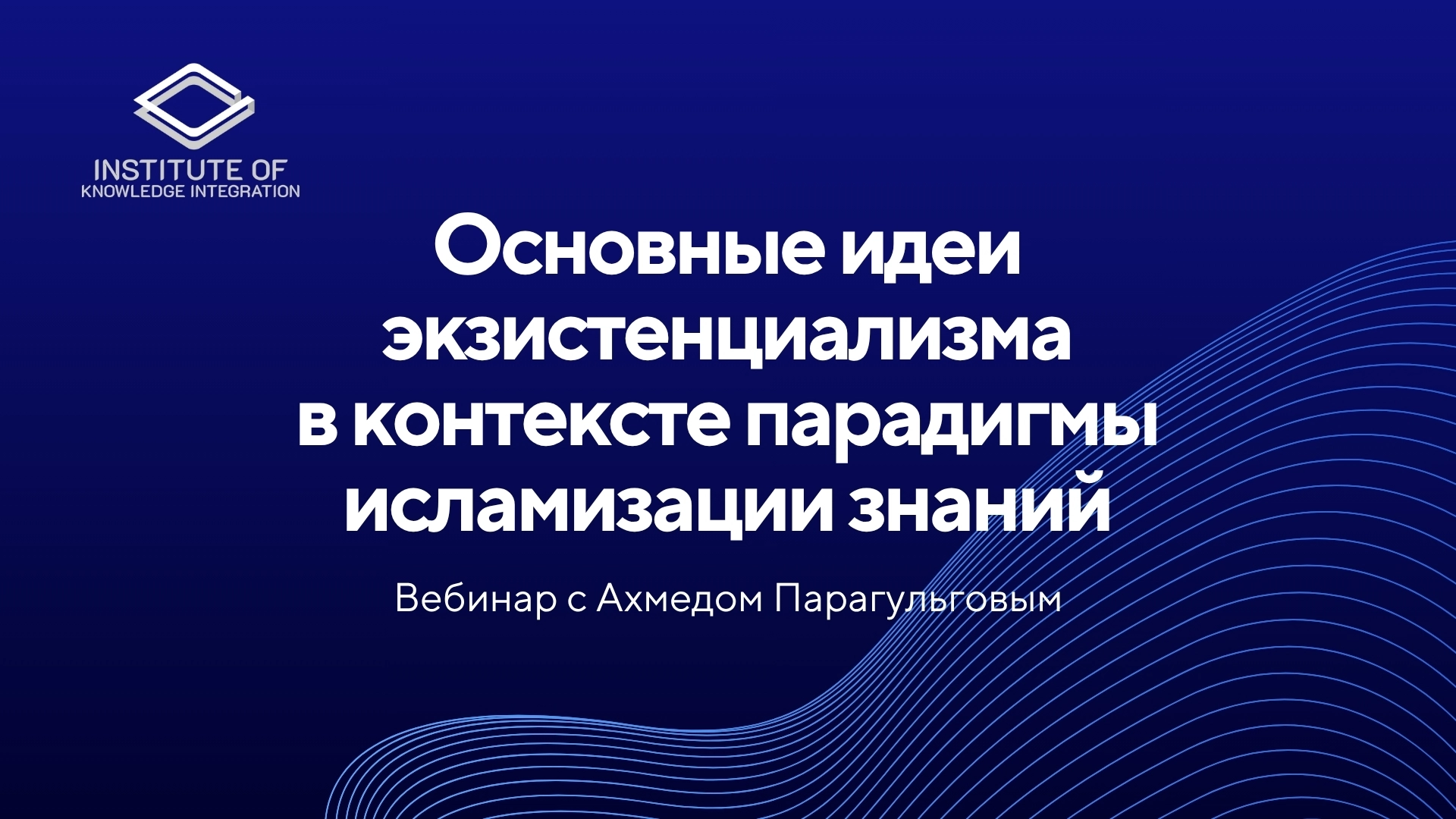
As part of the IIIT Lectures Series for CIS Countries project, a webinar was held on October 26, 2025:
“The Main Ideas of Existentialism in the Context of the Paradigm of the Islamization of Knowledge,” delivered by Ahmed Paragulgov.
Ahmed Paragulgov is a Candidate of Economic Sciences and a student of the Institute of Knowledge Integration.
The webinar explored the central ideas of existentialism — freedom, responsibility, essence, and absurdity — and examined how they compare with Islamic thought. Philosophy was presented not as something alien to Muslims, but as a tool for critically engaging with and integrating new forms of knowledge into Islamic civilization. The core question was: Is it possible to accept the existential challenge of meaning-seeking and self-determination while preserving Islamic values?
Existentialism emerged as a response to the spiritual crisis of the 20th century: wars, depression, and the collapse of traditional value systems. Its key concepts include:
Freedom — the human being is absolutely free to choose, yet bears full responsibility for every choice.
Essence and existence — a person first exists, and only then forms their essence, defining the priorities and values of their life.
The absurdity of being — the world lacks a single, clear meaning; atheist and religious existentialists interpret life’s meaning in different ways.
Suffering, anxiety, and loneliness — boundary states in which the person searches for meaning and shapes their self-understanding.
The speaker highlighted the potential for integrating existentialism into the Islamic intellectual tradition, noting that within such an integration, freedom is not an end in itself but a means for fulfilling the mission of being God’s vicegerent. Islamic categories can be deepened through existential experience, yet they cannot be fully reduced to Western interpretations.
In the concluding discussion, an example of conscious choice is given: freedom becomes a means for accepting the commandments of the Almighty, and the voluntary act of embracing religion illustrates the Islamic perspective on personal responsibility and servitude to God. Islam grants a person freedom of choice, but one’s mission and boundaries are set by divine revelation; responsibility for the choice rests entirely with the individual.
Conclusion:
Existentialism is viewed as an additional method of philosophical reflection that enriches the Islamic understanding of human nature, the role of freedom, the search for meaning, and responsibility. However, the foundational Islamic elements — fitrah, mission, and the relationship with God — remain decisive in shaping human essence and in overcoming the crises of modernity.