This paper, titled "Ibn Taymiyyah's Concept of Fitrah and Its Implications for Islamic Moral Thought" by Kazeem Akeem Olayinka, provides an in-depth investigation into the moral epistemology of the polymath Ibn Taymiyyah. While existing scholarship predominantly emphasizes his theological views, jurisprudence, or political treatises on jihad, this study addresses the academic gap regarding his theoretical framework of moral knowledge. Employing an inductive, library-based qualitative textual analysis of primary sources—such as Dar' Ta'arud, Majmu' al-Fatwa, al-Radd ala al-Mantiqiyyin, and Kitab al-Nubuwwat—the author demonstrates how Ibn Taymiyyah positions fitrah (innate human disposition) as a fundamental, non-inferential moral resource. The study highlights that fitrah is an innate psycho-spiritual faculty providing primordial moral consciousness, a intuitive grasp of right and wrong, and a natural inclination toward virtue. Crucially, the paper illustrates that Ibn Taymiyyah does not treat fitrah as a self-sufficient isolated element; instead, he integrates it with reason (intellect), divine revelation, sensory human experience, and non-reprehensible sociocultural realities. This synthetic framework offers a holistic moral paradigm in Islamic thought that transcends classical historical dichotomies between rationalist and scripturalist schools.
Abstract:
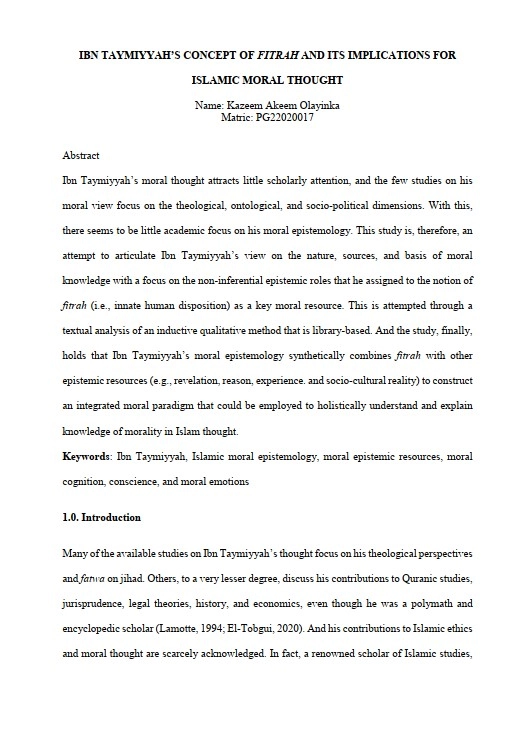
The Abstract outlines the primary objective of the study, which is to articulate Ibn Taymiyyah's overlooked moral epistemology with a focus on the concept of fitrah (innate human disposition). Utilizing a library-based inductive qualitative textual analysis, the paper asserts that Ibn Taymiyyah constructs a synthetic, integrated moral framework. This paradigm combines fitrah with revelation, reason, experience, and sociocultural realities to explain moral knowledge in Islamic thought.
1.0. Introduction:
The Introduction notes that existing literature on Ibn Taymiyyah concentrates mainly on theology, jihad, Quranic studies, and jurisprudence, while neglecting his moral epistemology. It critiques scholars like Majid Fakhry for claiming Ibn Taymiyyah lacked a moral perspective. The section outlines the paper's aim: to explore fitrah as an innate cognitive and psychological faculty and examine primary texts like Dar' Ta'arud, Majmu' al-Fatwa, al-Radd ala al-Mantiqiyyin, and Kitabu al-Nubuwwat.
2.0. An Overview of Ibn Taymiyyah’s Concept of Fitrah:
This section analyzes the linguistic roots and technical usages of fitrah in Islamic scriptural sources and critically reviews pre-existing scholarly interpretations (such as fitrah as Islam, Adamic covenant, predestination, neutral ability, or inner guidance). It presents Ibn Taymiyyah's distinct formulation of fitrah as an innate psycho-spiritual faculty, highlighting its defining characteristics: its innateness, susceptibility to corruption, impossibility of total eradication, and functional relationship with intellect and divine revelation.
3.0. Moral Epistemological Implications of the concept of Fitrah:
This section details how fitrah serves as an internal, non-inferential foundation for moral knowledge. It explains three major manifestations of fitrah: innate moral consciousness (intuitive discernment of virtue and vice), natural moral predisposition (unconscious preference for goodness and righteousness), and moral metacognition and emotions (such as conscience, shame, empathy, and remorse). It also links these insights to modern psychological and philosophical literature.
3.1. Intellect and Moral Knowledge:
This subsection explores the role of the intellect (reason) as an internal, rational epistemic faculty that develops over time. While fitrah provides non-inferential, basic moral intuition, the intellect provides inferred moral knowledge through analysis, synthesis, and contextualization. Ibn Taymiyyah agrees with the Mu'tazilites on human rational moral capacity but rejects their claim regarding reason's absolute sufficiency, asserting reason must operate in harmony with fitrah and revelation.
3.2. Revelation and Moral knowledge:
This subsection examines divine revelation (Qur'an and Hadith) as an external, authoritative, and uncorrupted moral resource. Revelation complements fitrah and intellect by providing explicit, detailed, and definitive moral prescriptions, rituals, and objective standards. Ibn Taymiyyah maintains that revelation does not contradict sound reason or pure fitrah; rather, it clarifies, confirms, and perfects man's innate moral disposition, contrasting with the Ash'arite exclusive reliance on revelation.
3.3. Human Experience and Knowledge of Morality:
This subsection addresses human experience as an empirical moral resource grounded in sensory perception and lived realities. Lived experience allows individuals to identify, verify, and confirm practical benefits and harms associated with actions. Continuous interaction between intellect and sensory data generates acquired moral knowledge. However, experience requires guidance from revelation and fitrah, alongside intellectual processing, to prevent delusions and evaluate novel situations correctly.
3.4. Sociocultural element and Moral Knowledge:
This subsection discusses sociocultural factors—such as social norms, cultural traditions, and societal mores—as external moral resources. Ibn Taymiyyah acknowledges that conventional morality can inform moral knowledge regarding public interest, societal benefit, and common good, provided it does not contradict explicit Islamic principles. This sociocultural element remains dynamic and regulated, subject to reformulation when evaluated against refined scriptural, rational, or experiential insights.
4.0. Conclusion:
The Conclusion summarizes the paper's findings, reiterating that Ibn Taymiyyah's moral epistemology represents a paradigmatic shift in Islamic thought by introducing fitrah as a central moral element. It emphasizes his integrative methodology, combining fitrah, revelation, reason, experience, and sociocultural context. Finally, it recommends future research into the interactive interplay of these five resources and the further exploration of Ibn Taymiyyah's Islamic moral psychology.
References:
The References section provides a comprehensive bibliography of primary classical texts authored by Ibn Taymiyyah and Ibn Manzur, alongside secondary academic literature by modern scholars including al-Afifi, al-Attar, Anjum, Bloom, Chittick, El-Tobgui, Fakhry, Hoover, Hourani, Kazi, Mohamed, Vasalou, and others, supporting the textual and analytical framework of the study.
The paper titled "Ibn Taymiyyah's Concept of Fitrah and Its Implications for Islamic Moral Thought," authored by Kazeem Akeem Olayinka (Matric: PG22020017), presents a rigorous academic investigation into the moral epistemology of the renowned medieval Islamic scholar Ibn Taymiyyah. The central thesis of the study posits that Ibn Taymiyyah developed an innovative, synthetic, and integrated paradigm of moral knowledge that elevates the concept of fitrah—defined as innate human disposition or primordial psycho-spiritual nature—to a foundational epistemic status, while harmonizing it with reason, divine revelation, empirical human experience, and sociocultural reality.
The document is structured logically across four main thematic sections: an Introduction outlining the research gap and primary sources; an Overview of Ibn Taymiyyah’s Concept of Fitrah dissecting its defining features and critique of earlier scholarly views; an extensive analysis of the Moral Epistemological Implications of Fitrah along with four distinct sub-modules on other epistemic resources (Intellect, Revelation, Human Experience, and Sociocultural elements); a Conclusion synthesizing the theoretical contributions; and a detailed References section.
In the introductory part of the study, the author establishes the academic rationale for the research. Despite Ibn Taymiyyah's standing as an encyclopedic polymath, existing scholarly literature has overwhelmingly focused on his theological treatises, legal rulings (fatwas) regarding jihad, jurisprudence, Quranic exegesis, and political theory. His contributions to ethics and moral philosophy have been largely neglected or dismissed; notably, prominent scholar Majid Fakhry asserted that Ibn Taymiyyah lacked any meaningful moral perspective. Furthermore, where moral epistemology was briefly noted, scholars often mischaracterized it as ambiguously analytical due to a failure to appreciate his integrative method. To rectify these misconceptions, Olayinka adopts an inductive qualitative methodology based on library research, examining core primary texts including Dar’ Ta’arud al-Aql wa al-Naql, Majmu’ al-Fatwa, al-Raddu ‘ala al-Mantiqiyyin, and Kitabu al-Nubuwwat.
The study then proceeds to reconstruct Ibn Taymiyyah’s definition of fitrah. Linguistically derived from the Arabic root fa-ta-ra (meaning to cleave open, originate, or bring into existence for the first time), the term appears over fifteen times in derivative forms in the Quran, and once as the exact noun fitrah in Surah Ar-Rum (Q30:30). Scripturally supported by prophetic traditions (such as the famous hadith stating that every infant is born upon the fitrah before parental influence alters them), classical scholars offered varied interpretations: fitrah as Islam (al-Tabari), as the Adamic covenant/Mithaq (Ahmad bn Hanbal), as predestination (Qadri al-Jaylani), as neutral human potentiality (Ibn Abdul Barr), or as inner spiritual conviction (Al-Ghazali). Ibn Taymiyyah critiques and refines these earlier positions. He rejects neutral ability and predestination, while clarifying that fitrah is not identical to Islam in its fully detailed, practical, and creedal sense. Instead, fitrah is an innate, psycho-spiritual, and cognitive faculty—a latent "Islamic predisposition" ontologically impressed into human nature that naturally aligns with divine truth and moral goodness.
Ibn Taymiyyah delineates several key characteristics of fitrah:
1. Innateness: It provides man with an a priori, non-inferential awareness of fundamental truths (e.g., God's existence and basic moral values) that are self-evident even if difficult to articulate verbally.
2. Susceptibility and Vulnerability: It is dynamic rather than static, highly prone to corruption by socio-psychological factors, parental upbringing, environmental influences, demonic whispers (Shaytan), forgetfulness, self-delusion, and egoism.
3. Impossibility of Total Alteration: Based on Q30:30 ("la tabdila li khaliqi allah"), fitrah cannot be completely eradicated or replaced. Even in deeply corrupted individuals, an indelible core of primordial goodness remains, explaining why humans experience conscience, guilt, remorse, and turn to God during severe adversity (Q10:22-23).
The central analytical contribution of the paper lies in articulating the moral epistemological implications of fitrah. Ibn Taymiyyah demonstrates that fitrah serves as an internal ground for morality through three manifestations: Innate Moral Consciousness (the intuitive capacity to distinguish basic virtues like justice and honesty from vices like deceit and cruelty without formal learning); Natural Moral Predisposition (an intrinsic desire and preference for virtuous acts and a natural revulsion toward evil); and Moral Metacognition and Emotions (innate psychological responses such as conscience, shame, empathy, disgust, and gratitude). The paper highlights how Ibn Taymiyyah's postulations pre-empted modern Western philosophical intuitionism (e.g., Rousseau's natural goodness of man, Sidgwick, Moore, Ross, Audi) as well as contemporary empirical moral psychology (e.g., Paul Bloom, J. Kiley Hamlin).
Crucially, Ibn Taymiyyah maintains that fitrah alone is insufficient to address complex moral realities. Consequently, he articulates a multi-faceted epistemic matrix comprising five interconnected elements:
- Fitrah: Internal, intuitive, non-inferential source providing primary moral orientation and basic awareness.
- Intellect (Reason): Internal, rational faculty that analyzes, synthesizes, infers, interprets scriptural commands, and contextualizes moral data.
- Revelation (Qur'an and Hadith): External, objective, uncorrupted authority providing explicit moral dictates, ritual obligations, and detailed guidance that reaffirms and perfects fitrah.
- Human Experience: Empirical resource utilizing sensory data to discover, verify, and confirm practical benefits and harms of actions in lived reality.
- Sociocultural Elements: External resource encompassing social norms and cultural customs that inform conventional morality and public welfare (maslahah), provided they conform to revelation and reason.
Ultimately, the paper concludes that Ibn Taymiyyah achieved a major paradigmatic shift in Islamic moral thought. By harmonizing these five epistemic elements, he avoided the theological reductionism of the Ash'arites (who restricted moral knowledge exclusively to divine revelation) and the Mu'tazilites (who overemphasized the absolute sufficiency of human reason). Ibn Taymiyyah’s model offers a holistic, integrated framework wherein revelation guides, reason processes, fitrah intuitively attests, experience empirically verifies, and sociocultural context practically applies moral knowledge.
Abstract:
The Abstract serves as a condensed overview of the entire scholarly paper, defining its scope, methodology, findings, and theoretical significance. It identifies a major gap in contemporary Islamic studies: while Ibn Taymiyyah’s theological, ontological, and socio-political ideas have been broadly analyzed, his moral epistemology remains largely unexplored. The author sets out to systematically articulate Ibn Taymiyyah's perspective on the nature, sources, and foundations of moral knowledge, focusing specifically on the non-inferential epistemic function assigned to fitrah (innate human disposition). The study adopts a library-based qualitative research methodology centered on textual analysis of primary works. The abstract concludes with the paper’s primary thesis: Ibn Taymiyyah does not isolate fitrah, but rather synthesizes it with divine revelation, intellect/reason, empirical experience, and sociocultural reality to construct an integrated moral paradigm capable of providing a comprehensive understanding of Islamic moral thought.
1.0. Introduction:
The Introduction provides background context, formulates the research problem, and details the textual corpus used in the investigation. The author observes that prevailing academic literature on Ibn Taymiyyah focuses disproportionately on his theological doctrines and his legal rulings concerning jihad, with secondary attention given to his contributions to Quranic exegesis, legal theory, history, and economics. Despite being recognized as an encyclopedic polymath, his contribution to Islamic moral thought is rarely acknowledged. To illustrate this neglect, the section cites Majid Fakhry’s categorical assertion in "Ethical Theories in Islam" that Ibn Taymiyyah lacked a meaningful moral perspective. The author refutes this claim, arguing that previous scholars failed to grasp Ibn Taymiyyah's integrated epistemological method and incorrectly labeled his work as ambiguously analytical (as noted by Vasalou and Hoover).
The Introduction explains that Ibn Taymiyyah was unique among Islamic theologians (Mutakallimun) in utilizing fitrah as a formal moral epistemic resource. While some modern scholars (such as Anjum, Kazi, al-Afifi, and Vasalou) have made tangential references to fitrah's ethical or theological importance, none have comprehensively mapped its epistemological implications. To achieve this, the paper draws directly upon key primary texts authored by Ibn Taymiyyah, specifically Dar’ Ta’arud al-Aql wa al-Naql, Majmu’ al-Fatwa, al-Raddu ‘ala al-Mantiqiyyin, and Kitabu al-Nubuwwat, supplemented by secondary scholarly literature.
Finally, the section outlines the paper's structural roadmap: first, providing an overview of Ibn Taymiyyah's conception of fitrah against the backdrop of earlier theological interpretations; second, examining the epistemic and moral implications of fitrah alongside reason, revelation, experience, and culture; and third, offering concluding observations on the significance of this integrated paradigm for understanding Islamic ethics.
2.0. An Overview of Ibn Taymiyyah’s Concept of Fitrah:
This section delivers an exhaustive examination of the concept of fitrah, tracing its linguistic origins, scriptural roots, historical interpretations, and Ibn Taymiyyah’s distinct theoretical formulation. Linguistically, fitrah derives from the Arabic root letters fa-ta-ra, meaning "to cleave open," "to originate," or "to cause something to exist for the first time" (Ibn Manzur). In scriptural sources, derivatives of the term appear over fifteen times in the Quran, appearing once as the exact noun fitrah in Surah Ar-Rum (Q30:30). It is heavily supported by prophetic traditions, notably the canonical hadith recorded in Sahih Bukhari and Sahih Muslim where the Prophet Muhammad states that every child is born according to their true nature (fitrah) before their parents convert them into Jews, Christians, or Magians.
Prior to Ibn Taymiyyah, classical Muslim scholars held diverse views regarding fitrah:
- Fitrah as Islam: al-Tabari (d. 923 AD) identified fitrah directly with the formal religion of Islam.
- Fitrah as Mithaq (Adamic Covenant): Ahmad bn Hanbal (d. 855 AD) associated fitrah with the primordial covenant described in Q7:172-173.
- Fitrah as Predestination: Qadri al-Jaylani (d. 1166 AD) interpreted fitrah in terms of divine decree.
- Fitrah as Neutral Ability: Ibn Abdul Barr (d. 1071 AD) viewed fitrah as a blank slate or neutral potentiality lacking inherent inclination.
- Fitrah as Inner Guidance: Al-Ghazali (d. 1111 AD) viewed fitrah as internal spiritual light and conviction.
Ibn Taymiyyah critically evaluates and refines these earlier views. He categorically rejects the notions of "predestination" and "neutral ability." Regarding the equation of fitrah with Islam, he introduces a vital nuance: fitrah is not Islam in its complete, detailed, practical, and creedal sense, but rather an innate, psycho-spiritual, and cognitive faculty that represents a natural predisposition toward Islam ("Islam in its human potentiality"). It is part of man’s ontological constitution and functionally compatible with divine revelation. Regarding the Adamic covenant (Mithaq), Ibn Taymiyyah argues that the covenant does not constitute fitrah itself, but presupposes it; the human capacity to affirmatively answer God's primordial question reflects an innate, non-inferential awareness.
Ibn Taymiyyah establishes three defining characteristics of fitrah:
1. Innateness: Fitrah is an a priori epistemic faculty furnishing self-evident awareness of reality (such as God's existence and core moral principles) beneath the conscious mind.
2. Susceptibility and Vulnerability: Fitrah is dynamic and vulnerable to external corruption. Citing prophetic traditions and Q114, Ibn Taymiyyah notes that socio-psychological influences, parental upbringing, societal conditioning, demonic factors (Shaytan), forgetfulness, self-delusion, and egoism can obscure and distort fitrah.
3. Impossibility of Total Alteration: Based on Q30:30 ("la tabdila li khaliqi allah"), Ibn Taymiyyah asserts that fitrah can never be completely eradicated or replaced. Even in deeply corrupted individuals, a core of primordial goodness survives, manifesting as conscience, remorse, and an instinctive turning to God during dire adversity (Q10:22-23).
Furthermore, the section introduces Ibn Taymiyyah’s initial mapping of fitrah in relation to revelation and intellect: fitrah provides general, unlearned, non-inferential knowledge; revelation supplies explicit, detailed principles; and the intellect analyzes, synthesizes, and contextualizes both.
3.0. Moral Epistemological Implications of the concept of Fitrah:
This section explores how Ibn Taymiyyah transforms fitrah from a purely theological construct into a pivotal element of moral epistemology. While previous literature focused on fitrah's theological implications (Holtzman, Hoover, Kazi), political framework (Anjum), psychological aspects (Mohamed), or pedagogical value (al-Bishi), very few scholars (al-Afifi, Vasalou) examined its role in moral knowledge. Ibn Taymiyyah demonstrates that fitrah acts as an internal epistemic resource that grounds human morality.
The author highlights three primary moral manifestations of fitrah:
1. Innate Moral Consciousness: This is an instinctive, non-inferential capacity to discern basic moral values and concepts (such as justice, fairness, truthfulness, honesty, cruelty, and deceit) without prior formal training or social learning. It functions as a native moral compass inherent to all human beings.
2. Natural Moral Predisposition: Fitrah instills an unconscious inclination toward moral goodness and an innate aversion to evil. Ibn Taymiyyah argues that human beings naturally desire, admire, and take pleasure in virtuous behavior and righteous individuals, while experiencing inherent revulsion toward malicious acts. Even perpetrators of evil typically conceal their actions or attempt rationalizations, reflecting an implicit recognition of moral standards.
3. Moral Metacognition and Emotions: Ibn Taymiyyah identifies specific metacognitive attitudes and emotional reactions as innate epistemic expressions of fitrah. These moral emotions—including conscience, shame, empathy, remorse, disgust, and gratitude—serve as self-evaluative mechanisms that disturb individuals when they violate moral norms and affirm them when they act virtuously.
To demonstrate the broad relevance of Ibn Taymiyyah’s thought, the section compares his ideas to Western philosophy and modern science. His emphasis on innate moral intuition pre-empts Jean-Jacques Rousseau’s concept of the "natural goodness of man" and his vulnerability to social corruption. It also aligns with ethical intuitionism (Sidgwick, Moore, Ross, Audi, Oakley, Roeser) and contemporary empirical research in moral psychology (such as Paul Bloom's "Just Babies" and J. Kiley Hamlin's studies on preverbal infants), which prove that basic moral evaluations are present in early childhood before formal socialization.
The section concludes by noting that despite fitrah's foundational importance, Ibn Taymiyyah explicitly insists that it is not self-sufficient. Because fitrah can be corrupted and lacks detailed legal specifications, it must be combined with four other moral epistemic resources: intellect, revelation, human experience, and sociocultural elements.
3.1. Intellect and Moral Knowledge:
This subsection examines the second internal epistemic resource in Ibn Taymiyyah's moral framework: the intellect (reason). The author notes that while academic distinctions exist between "intellect" and "reason" (Kalin, Chittick), they are used interchangeably here as operational aspects of cognitive processing. Unlike fitrah, which is active at birth as a primordial orientation, the intellect is latent in infants and develops over time (Bloom, Ali).
Intellect functions as a rational epistemic faculty capable of analysis, synthesis, evaluation, inference, and contextualization. In the realm of morality, a sound intellect possesses the rational capacity to identify beneficial acts, apprehend evil, and discern moral implications (al-Afifi, Ibn Taymiyyah). The author compares Ibn Taymiyyah's view of reason with that of the Mu'tazilites. Like the Mu'tazilites, Ibn Taymiyyah affirms that human reason has the innate capacity to comprehend and articulate moral values. However, he sharply diverges from them regarding reason's absolute sufficiency. He rejects the Mu'tazilite claim that reason alone can independently determine all moral truths and obligations without scripture.
Within Ibn Taymiyyah’s framework, fitrah provides non-inferential, self-evident moral intuitions, while the intellect provides inferred, ratiocinated moral knowledge. The intellect processes sensory data from human experience, interprets scriptural commands from revelation, and reflects upon self-evident truths provided by fitrah. A pure fitrah keeps reason aligned with truth, whereas a corrupted fitrah causes the intellect to lose its balance and fall into self-delusion.
3.2. Revelation and Moral knowledge:
This subsection analyzes divine revelation (the Qur'an and Sunnah) as an external, objective, and authoritative moral epistemic resource. In contrast to fitrah and intellect, revelation provides explicit, specific, and definitive moral injunctions, prohibitions, ritual regulations, and legal standards that cannot be derived through intuition or reason alone (Q2:38; Q20:123).
Ibn Taymiyyah emphasizes that divine revelation does not oppose or overwrite pure fitrah or sound reason. Instead, revelation reaffirms, clarifies, and perfects man's innate moral disposition (Ibn Taymiyyah 1991). Scriptural commands command what is naturally pure to the heart and rationally beneficial to human wellbeing. Revelation provides an uncorrupted external benchmark against which corrupted fitrah or distorted reason can be corrected.
The author contrasts Ibn Taymiyyah’s balanced approach with the Ash'arite school of theology. The Ash'arites maintained that revelation is the sole source of moral knowledge, denying that human reason or nature possesses any intrinsic capacity to recognize moral good or evil prior to divine command. Ibn Taymiyyah rejects this divine command exclusivism, pointing out numerous Quranic passages (Q8:22; Q47:10; Q21:78) where God explicitly appeals to human intellect, sensory observation, and innate disposition (fitrah) to validate moral and spiritual truths.
3.3. Human Experience and Knowledge of Morality:
This subsection investigates the epistemic function of human experience as an empirical source of moral knowledge. Grounded in sensory perception (the five senses) and lived reality, experience enables individuals to discover, confirm, and verify the practical benefits (maslahah) and harms (mufsadah) associated with human actions (Ibn Taymiyyah, al-Afifi, McGrath).
Through continuous interaction between the intellect and sensory experience, humans accumulate learned moral knowledge. Past experiences of harm or benefit allow individuals to evaluate complex moral situations, formulate practical judgments, and make informed ethical decisions in similar future contexts. Lived experience makes moral knowledge concrete and empirically verifiable.
However, experience cannot function in isolation. The intellect is required to organize sensory data and guard against cognitive biases, phobias, and delusions. Furthermore, revelation and fitrah are necessary to provide overarching moral guidance, particularly when encountering novel or ambiguous circumstances where past experience is insufficient. Thus, experience supplies raw empirical data that intellect processes within the ethical boundaries established by fitrah and scripture.
3.4. Sociocultural element and Moral Knowledge:
This subsection explores the moral epistemic role of sociocultural elements, including social norms, custom ('urf), and cultural traditions. Sociocultural elements represent external resources reflecting the collective lived reality and historical experience of a community within a specific locality.
Ibn Taymiyyah recognizes conventional morality and social customs as valid secondary sources of moral knowledge, particularly regarding matters of public welfare, common interest, and societal benefit (maslahah) (Opwis, Vasalou, Mangini, Hoover). He permits reliance on cultural norms to determine moral obligations in areas not explicitly defined by scripture, provided two conditions are met:
1. The cultural practices must not contradict any explicit or validly derived principle of Islamic revelation.
2. The norms must deliver tangible societal benefits or prevent harm within the community.
Importantly, Ibn Taymiyyah views sociocultural elements as dynamic and subordinate to higher epistemic resources. Conventional morality remains subject to continuous regulation and reformulation whenever new scriptural insights, rational arguments, or empirical experiences demonstrate a need for adjustment.
4.0. Conclusion:
The Conclusion synthesizes the core findings of the study, reiterating that Ibn Taymiyyah's conceptualization of fitrah represents a major paradigmatic shift in the history of Islamic moral philosophy. By positioning fitrah as a primordial, non-inferential, psycho-spiritual faculty, Ibn Taymiyyah established an internal foundation for moral intuition, moral emotions, and innate moral consciousness.
Crucially, the conclusion reinforces that Ibn Taymiyyah’s greatest contribution lies in his integrative methodology. He successfully synthesized five distinct epistemic resources:
1. Fitrah (innate disposition providing non-inferential moral orientation)
2. Intellect (reason providing analytical processing and inferred knowledge)
3. Revelation (scripture providing objective, definitive standards)
4. Human Experience (sensory data providing empirical verification of harm and benefit)
5. Sociocultural Elements (customs providing context-specific conventional morality)
This holistic framework avoids the partiality of both Ash'arite scriptural exclusivism and Mu'tazilite rationalist reductionism. Finally, the author suggests two avenues for future academic research: further exploring the interactive interplay among these five moral epistemic resources, and developing a comprehensive model of Islamic moral psychology based on Ibn Taymiyyah's writings.
References:
The References section contains a complete bibliography of primary and secondary sources cited throughout the paper. Primary sources include critical Arabic editions of Ibn Taymiyyah’s major works—Dar’u ta’aridi al-‘Aqli wa al-Naqli (ed. Muhammad Rashaad Saalim), al-Raddu ‘ala al-Mantiqiyyin, Kitab al-Nubuwwat, and Majmu’ Fatawa (ed. Ibn Qasim)—as well as Ibn Manzur’s classical Arabic dictionary Lisan al-'Arab.
Secondary sources comprise prominent modern scholarly studies in Islamic ethics, theology, and moral psychology, including works by M.A. al-Afifi, M. al-Attar, M.Y. Ali, O. Anjum, P. Bloom, W.C. Chittick, C.S. El-Tobgui, M. Fakhry, L. Holtzman, J. Hoover, G.F. Hourani, I. Kalin, Y. Kazi, T. Kukkonen, V. Lamotte, V.E. Makari, M. Mangini, S. McGrath, Y. Mohamed, A.Z. Muhammad al-Bishi, J. Oakley, F. Opwis, M.S. Özervarli, and S. Roeser.