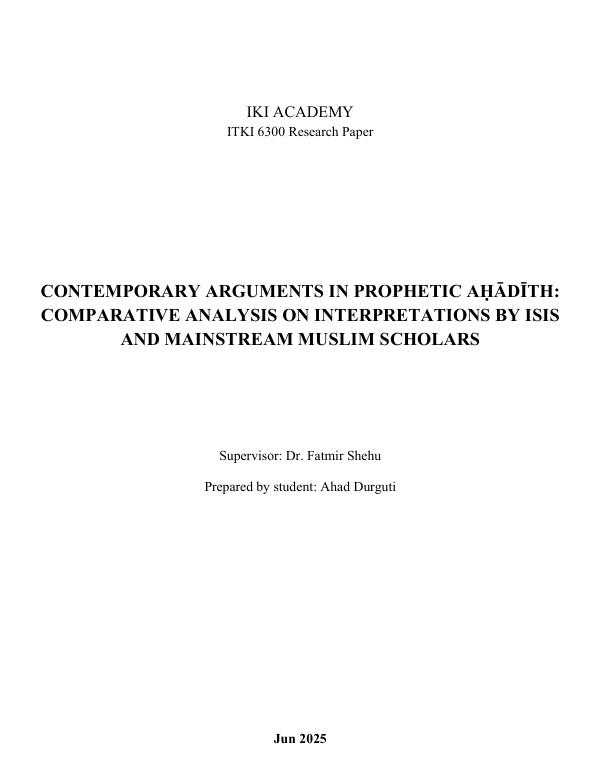
This research paper, titled 'Contemporary Arguments in Prophetic Aḣādīth: Comparative Analysis on Interpretations by ISIS and Mainstream Muslim Scholars' and authored by student Ahad Durguti under the supervision of Dr. Fatmir Shehu, investigates the ideological misuse of sacred texts by the extremist group ISIS. The study focusing on three specific Prophetic traditions (Aḣādīth): 'Know that paradise is under the shade of swords', the hadith of the 'Black Banners from Khorasan', and 'I have been commanded to fight the people...'. By comparing the selective, decontextualized, and literalist hermeneutics of ISIS with the highly contextual, jurisprudential, and ethical methodologies of mainstream classical and contemporary Muslim scholarship, the paper exposes the deep methodological distortions employed by extremist movements. Additionally, the research analyzes the critical societal and global consequences of these divergent interpretations, discussing their role in youth radicalization, intra-religious sectarian polarization, the rise of Islamophobia, and diplomatic complications. Ultimately, this academic work emphasizes the crucial need for authentic Islamic scholarship, curriculum reform, and targeted counter-narrative strategies to reclaim Islamic discourse from extremist manipulation and safeguard both faith and global society.
Abstract: Summarizes the entire study, highlighting its focus on ISIS's ideological manipulation of three specific Hadiths, the qualitative comparative methodology used, and the broader social and policy implications of these divergent interpretations.
Chapter 1: Introduction: Outlines the global challenges facing the Muslim Ummah, details the problem statement regarding the weaponization of Hadiths, presents key research questions and objectives, and provides historical background on ISIS's emergence in 2014.
Chapter 2: Literature Review: Synthesizes classical scholarship and modern academic research on Hadith interpretation and extremist methodologies, while identifying research gaps concerning direct theological comparative frameworks of specific narratives.
Chapter 3: Research Methodology: Explains the descriptive, analytical-interpretive, and comparative qualitative methods used, outlining the primary and secondary sources utilized to analyze and correct the misinterpretations of the chosen texts.
Chapter 4: Analysis of ISIS Interpretation of Hadith: Investigates how ISIS employs selective literalism and decontextualization to transform the three chosen Hadiths into tools for legitimizing suicide bombings, recruiting youth, and claiming apocalyptic authority.
Chapter 5: Comparative Analysis with Mainstream Islamic Interpretations: Evaluates the chosen Hadiths in light of classical and contemporary mainstream scholarship, demonstrating that traditional interpretations emphasize defensive contexts, ethical limits, and strict verification of authenticity.
Chapter 6: Discussion on Impacts of Divergent Interpretations: Examines how the clashing interpretations of jihad and eschatology impact Muslim communities, fuel global Islamophobia, damage inter-religious relationships, and shape contemporary counter-extremism policies.
Chapter 7: Conclusion and Recommendations: Consolidates the study's findings regarding the methodological flaws of ISIS and presents action-oriented recommendations for scholars, community leaders, policymakers, and international peacebuilding organizations.
Bibliography: Lists the comprehensive primary classical texts, works of contemporary Islamic scholars, and academic books and articles that formed the scholarly foundation of this comparative research paper.
The research paper 'Contemporary Arguments in Prophetic Aḣādīth: Comparative Analysis on Interpretations by ISIS and Mainstream Muslim Scholars' presents a rigorous, qualitative investigation into how religious texts are weaponized by extremist movements, specifically the Islamic State of Iraq and Syria (ISIS). Authored by student Ahad Durguti and supervised by Dr. Fatmir Shehu at the IKI Academy in June 2025, the paper utilizes a comparative framework to deconstruct the hermeneutical methodologies of extremist propaganda and contrast them with authentic, mainstream Islamic scholarship.
The core of the study revolves around three specific Prophetic traditions (Aḣādīth) that are frequently cited in ISIS publications such as Dabiq and Rumiyah. These are: (1) 'Know that paradise is under the shade of swords' (Sahih al-Bukhari, 2818); (2) 'the Black Banners from Khorasan' (Sunan Ibn Majah, 4084); and (3) 'I have been commanded to fight the people until they testify that there is no god but Allah' (Sahih al-Bukhari, 25 and Sahih Muslim, 22). The author argues that ISIS isolates these texts from their historical, legal, and linguistic contexts, interpreting them through an ultra-literalist, militaristic lens to validate violent practices like suicide bombings, takfir (excommunication), and the slaughter of non-combatants.
To counter this ideological manipulation, the paper details the traditional methodologies of classical and contemporary mainstream scholars. Mainstream Islamic scholarship utilizes a holistic approach that relies on critical tools such as 'ilm al-rijal (biographical evaluation of narrators), isnad (chain of transmission) authentication, asbab al-wurud (the historical circumstances surrounding the utterance of a Hadith), and alignment with the maqasid al-shari'ah (the higher objectives of Islamic law, such as the preservation of life, intellect, and freedom of belief).
Through this comparative lens, the research demonstrates how mainstream scholars have historically restricted and qualified these Hadiths. For instance, the 'shade of swords' Hadith is classically understood as a motivational statement spoken in a specific defensive context (like the Battle of Uhud), governed by strict ethical guidelines that forbid harming women, children, and non-combatants. The hadith of the 'Black Banners' is exposed as textually weak (da'if) or fabricated (mawdu'), meaning it is theologically and legally invalid for declaring war or establishing political legitimacy. The command to 'fight the people' is shown to be a time-bound directive targeted specifically at the hostile polytheists of Quraysh who had repeatedly broken treaties, rather than a universal mandate for coercive conversion.
The paper's structure seamlessly connects these theological analyses to their real-world consequences, exploring the deep sociological and geopolitical impacts of these divergent interpretations. The manipulation of Hadiths by ISIS is shown to cause severe social polarization, accelerate youth radicalization, and erode public trust in traditional religious authority. Globally, it fuels Islamophobia, provides ammunition for biased media misrepresentations, and places diplomatic strain on Muslim-majority nations. Finally, the study concludes with practical recommendations designed to neutralize extremist narratives, calling for curriculum reforms in Islamic schools, active engagement of religious scholars in deradicalization and policymaking, and the promotion of inter-religious dialogue.
Abstract & Chapter 1: Introduction:
This section introduces the foundational parameters of the research paper. It establishes the global crisis currently affecting the Muslim Ummah, highlighting internal challenges like governance shifts and external factors such as geopolitical interventions by global superpowers. Amidst this instability, extremist movements like ISIS have emerged, claiming to represent Islamic orthodoxy while weaponizing sacred Prophetic Aḣādīth to legitimize violence. The author outlines the research questions and objectives, focusing on how ISIS's selective and literalist interpretations compare to the context-sensitive, ethically grounded approaches of mainstream scholars. This section also provides vital historical background on ISIS as a movement, detailing its rise in 2014 under Abu Bakr al-Baghdadi, its declaration of a caliphate, and its use of English-language magazines like Dabiq and Rumiyah to disseminate propaganda and recruit disillusioned youth.
Chapter 2: Literature Review:
This chapter synthesizes extensive scholarly work from classical commentators, modern Islamic thinkers, and contemporary counter-terrorism experts. It highlights classical methodologies, referencing works like Fath al-Bari by Ibn Hajar al-'Asqalani and Sharh Sahih Muslim by Imam al-Nawawi, which emphasize historical context (asbab al-wurud) and textual harmonization. Contemporary scholars such as Jonathan A.C. Brown and David Cook are discussed to illustrate how modern extremists engage in 'cut-and-paste' theology, stripping texts of their ethical and jurisprudential constraints. The literature review also incorporates reports from international bodies like the United Nations and the Singapore-based Religious Rehabilitation Group (RRG). The author identifies a critical academic gap: the lack of studies directly comparing specific Hadith interpretations between radical groups and mainstream scholars, which this research aims to address.
Chapter 3: Research Methodology:
This section explains the qualitative research design adopted by the author, which is grounded in an interpretivist paradigm. The methodology combines descriptive, analytical-interpretive, and comparative methods to investigate how sacred texts are manipulated for ideological ends. The author details the primary sources of the study, which are the three selected Hadiths as they appear in ISIS publications and classical commentaries. Secondary materials are identified as academic literature, policy reports from organizations like the Brookings Institution and the International Crisis Group, and scholarly articles on jihadist theology. The methodological aim is defined as both analytical and corrective, seeking to expose textual distortions, reaffirm the importance of context, and contribute to religion-based counter-extremism strategies.
Chapter 4: Analysis of ISIS Interpretation of Hadith:
This chapter provides an in-depth analysis of how ISIS interprets and weaponizes the three selected Hadiths. For Hadith 1 ('Know that paradise is under the shade of swords'), ISIS takes the metaphor of the sword literally to frame continuous armed struggle as an individual religious duty and the most direct path to paradise, utilizing this narrative to justify suicide bombings and recruit vulnerable youth. For Hadith 2 ('The Black Banners from Khorasan'), ISIS uses this apocalyptic prophecy to claim eschatological legitimacy, designing its black flag to evoke the banner and declaring its fighters to be the army of the Mahdi. For Hadith 3 ('I have been commanded to fight the people...'), ISIS utilizes a literal and absolute interpretation of 'al-nas' (all people) to establish a theological foundation for offensive jihad, takfir (excommunication), and the forced conversion or execution of non-Muslims and dissenting Muslims.
Chapter 5: Comparative Analysis with Mainstream Islamic Interpretations:
This chapter serves as the academic core of the paper, systematically refuting ISIS's claims through classical and contemporary scholarship. For the 'shade of swords' Hadith, the author shows that classical scholars like Ibn Hajar, Al-Nawawi, and Al-Khattabi interpret it metaphorically and place it within defensive military contexts like the Battle of Uhud, governed by strict rules prohibiting the harming of innocents. For the 'Black Banners' Hadith, mainstream critics like Al-Albani, Al-Dhahabi, and Shu'ayb al-Arna'ut prove the narration is textually weak (da'if) or fabricated (mawdu'), rendering it useless for establishing political or legal authority. For the third Hadith ('I have been commanded to fight...'), jurists explain that 'the people' refers specifically to the hostile polytheists of Quraysh who broke treaties, and that forced conversion directly contradicts Quranic principles of religious freedom (e.g., 'There is no compulsion in religion'). This chapter establishes a fundamental epistemological rift between ISIS's ideological absolutism and the scholarly integrity of traditional Islam.
Chapter 6: Discussion on Impacts of Divergent Interpretations:
This section analyzes the multi-level sociological, political, and diplomatic consequences of these conflicting interpretations. Within Muslim societies, extremist distortions lead to severe sectarian polarization through takfir, accelerate youth radicalization, and erode public trust in established religious institutions. Globally, the sensationalist media coverage of extremist violence fuels widespread Islamophobia and hate crimes, while misrepresenting ISIS's ideology as 'authentic Islam'. The author notes that this creates diplomatic strain for Muslim-majority nations, which are pressured to defend themselves against acts they do not support. Conversely, the section highlights that mainstream interpretations offer a stabilizing force by promoting interfaith dialogue, religious pluralism, and ethical counter-extremism policies like educational curriculum reform.
Chapter 7: Conclusion and Recommendations:
This final chapter consolidates the research findings and outlines actionable pathways forward. The author summarizes that while ISIS relies on literalist, decontextualized, and fabricated narratives to justify violence and establish illegitimate authority, mainstream scholarship offers a holistic, compassionate, and legally disciplined methodology. Based on these findings, targeted recommendations are provided for four groups: (A) Islamic scholars and schools, calling for a revival of contextual Hadith methodology; (B) religious and community leaders, to lead awareness campaigns and provide spiritual guidance; (C) policymakers and counterterrorism agencies, to include scholars in deradicalization programs and avoid securitizing Muslim communities; and (D) international organizations, to support interfaith dialogue and research addressing root causes of extremism. The chapter concludes with a final reflection on the responsibility to defend the prophetic legacy from ideological abuse.
Bibliography:
This section contains the comprehensive list of scholarly sources that anchor the paper's findings. It is organized into three main categories: Primary Sources (Classical Texts), which includes foundational works of Islamic jurisprudence and Hadith commentaries like those by Al-Bukhari, Al-Muslim, Al-Nawawi, Ibn Hajar, Al-Mawardi, and Ibn Taymiyyah; Contemporary Islamic Scholars, featuring modern fatwas and treatises by Al-Albani, Ibn Baz, Ibn 'Uthaymin, and Al-Qaradawi; and Academic Books and Articles, which references modern research on violent extremism, media representation, and international relations by authors such as Olivier Roy, John Esposito, and Peter Neumann.