

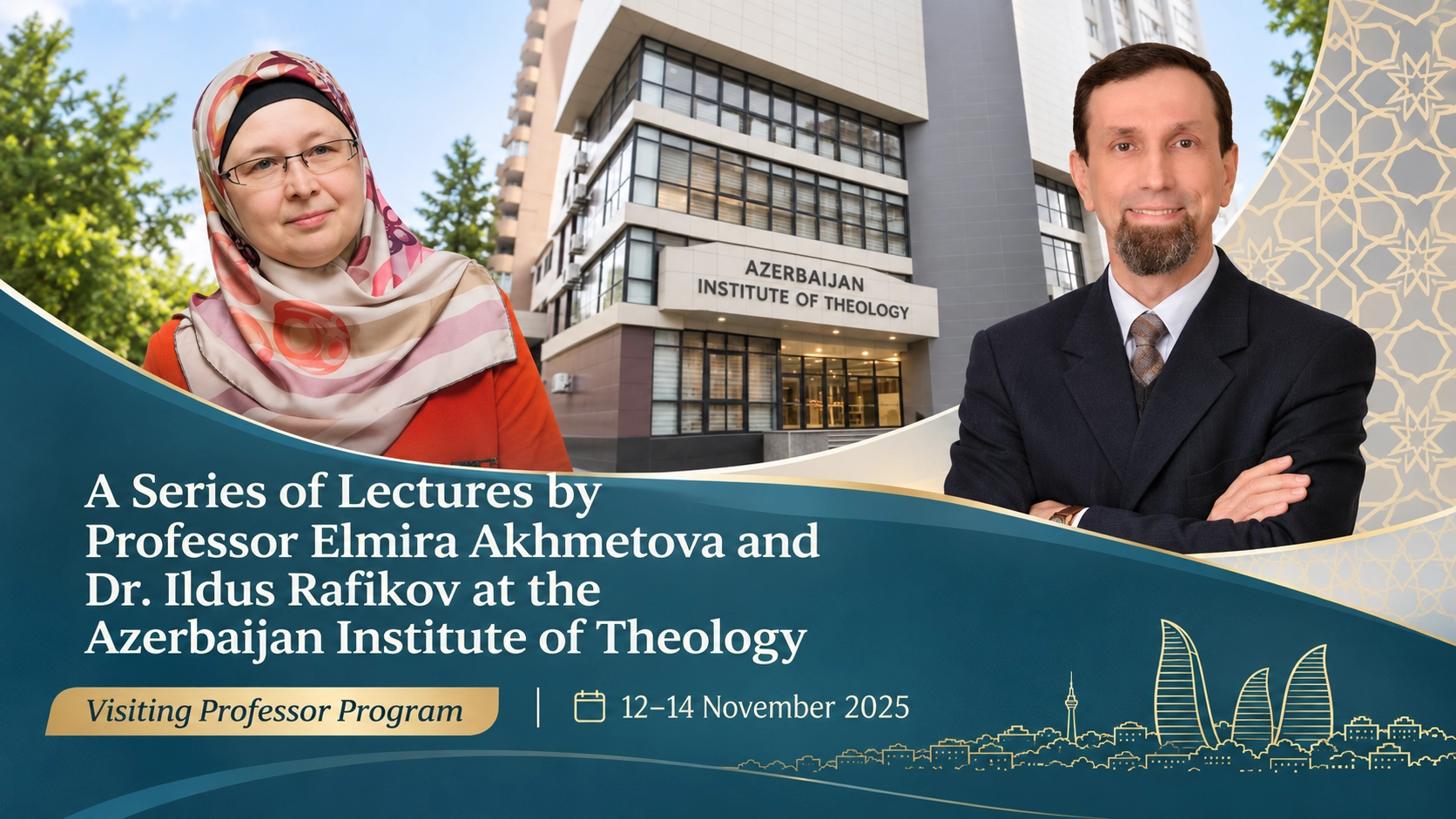
From November 12 to 14, 2025, the Azerbaijan Institute of Theology in Baku hosted a series of academic lectures delivered by Professor Elmira Akhmetova, Director of Research and Grants at the Institute of Knowledge Integration (IKI), and Dr. Ildus Rafikov, Vice President for Research at the Maqasid Institute. The lectures were organized as part of the international Visiting Professor Program and focused on the intellectual heritage of Islamic civilization, the development of scientific knowledge, Islamic educational traditions, and contemporary approaches to Islamic studies.
The initiative aimed to strengthen international academic cooperation, expand educational and research partnerships, and introduce students to various dimensions of the Islamic intellectual tradition. The program was coordinated with the participation of the İdrak Public Association.
Professor Elmira Akhmetova's academic program explored the development of science and educational institutions in Islamic civilization, as well as the Qur'anic understanding of history. Particular attention was devoted to the place of knowledge in the Islamic worldview, the intellectual achievements of Muslim scholars, and the relevance of historical heritage to contemporary society.
One of the central topics was "Development of Science during Islamic Civilization." The lecture examined the achievements of Muslim scholars across various fields of knowledge, including mathematics, medicine, astronomy, optics, geography, and engineering.
Drawing on the scientific legacies of al-Khwarizmi, Ibn al-Haytham, and al-Jazari, the lecture highlighted the contribution of Islamic civilization to the development of global science. Particular emphasis was placed on the translation movement, through which scholarly works from different cultures and historical periods became part of a shared intellectual tradition, as well as on the role of Muslim scholars in preserving, systematizing, and advancing scientific knowledge.
An important aspect of the lecture was the examination of science in the context of the Qur'anic call to reflect upon the created universe. Scientific inquiry was presented not merely as a means of acquiring new knowledge but also as an endeavor contributing to the improvement of human life, social well-being, and a responsible relationship with the surrounding world.
Another lecture by Professor Akhmetova, "Educational Institutions in Islamic Civilization," focused on the emergence and development of educational systems throughout the Muslim world.
The lecture examined the educational functions of mosques, the tradition of study circles known as halaqat, the activities of elementary schools such as kuttab and maktab, and the development of madrasahs and institutions of higher learning. Drawing on examples of renowned historical centers of education, including al-Qarawiyyin and al-Azhar, the lecture highlighted the importance of Islamic educational institutions in disseminating both religious and secular knowledge.
Special attention was given to the tradition of transmitting knowledge from teacher to student, the ijazah system, the role of scholars in shaping intellectual environments, and access to education. The history of Islamic educational institutions was presented as an example of the close relationship between scientific advancement, spiritual and moral development, and social responsibility.
Another significant topic was "The Qur'anic Concept of the Past." In this lecture, Professor Elmira Akhmetova addressed questions of historical consciousness, the importance of studying the past within the Islamic tradition, and the distinctive features of the development of Muslim historiography.
The lecture examined methods of collecting, verifying, and interpreting historical information, as well as the contributions of early Muslim historians, including Ibn Ishaq and al-Tabari, to the emergence of historical scholarship.
A central focus was the analysis of Qur'anic narratives concerning historical events and the destinies of earlier communities. It was emphasized that references to the past in the Qur'an serve not only an educational purpose but also a profound moral one, encouraging individuals to draw lessons from history, reflect on the consequences of human actions, and recognize their responsibilities toward future generations.
Dr. Ildus Rafikov's academic program addressed methodological and applied issues in contemporary Islamic scholarship, including the objectives of Islamic law, the integration of religious and modern scientific approaches, and the development of socially significant institutions within the Islamic tradition.
One of the key topics was "Introduction to Maqasid Al-Shari'ah," a lecture dedicated to the higher objectives and purposes of Islamic law.
The lecture examined classical approaches to understanding maqasid, including the preservation of religion, life, intellect, progeny, and property, as well as contemporary interpretations of this framework that emphasize justice, human dignity, and social well-being.
Particular attention was devoted to the significance of maqasid methodology in addressing contemporary social, economic, and ethical questions. This approach makes it possible to understand Islamic law not only through individual legal provisions but also through the underlying values, objectives, and principles that inform them.
Another important area of discussion was the Two Readings methodology developed by the distinguished Islamic thinker Taha Jabir al-Alwani. The lecture "The Two Readings Approach for Modern Islamic Studies" focused on the interconnected study of Divine Revelation and the created universe.
This concept emphasizes the integration of Qur'anic principles with scientific knowledge of the natural and social world. The lecture explored ways of overcoming the divide between religious and modern scientific disciplines and developing a holistic approach to studying contemporary challenges in human development.
Special attention was given to the concept of the higher Qur'anic objectives, encompassing tawhid – the oneness of God, tazkiyah – spiritual and moral purification, and umran – the constructive development of human civilization. These principles were examined as the foundation of an integrative approach to education, scientific research, and societal well-being.
A separate lecture by Dr. Ildus Rafikov addressed the sustainable development of the waqf institution in the digital era, under the title "Essential Prerequisites for Sustainable Awqaf in the Digital Age."
The presentation explored the religious, ethical, and cultural foundations of charitable activity, the importance of public trust and transparency, and the development of a culture of giving. Particular emphasis was placed on the role of waqf as a historically significant institution of Islamic civilization that contributed to the advancement of education, science, healthcare, and social welfare.
This discussion provided an opportunity to examine ways of preserving and developing traditional Islamic charitable institutions under contemporary conditions, as well as the importance of responsible governance and community participation in ensuring their long-term sustainability.
The interdisciplinary nature of the academic program added particular significance to the lectures. The topics presented by Professor Elmira Akhmetova and Dr. Ildus Rafikov brought together the history of Islamic civilization, theology, philosophy, educational studies, and contemporary approaches to the study of social institutions.
The series of lectures at the Azerbaijan Institute of Theology formed part of the international Visiting Professor Program implemented by the Institute of Knowledge Integration to promote academic mobility, strengthen educational and research partnerships, and expand opportunities for intellectual exchange among scholars and universities from different countries.
Such initiatives help familiarize university communities with contemporary developments in Islamic studies, create opportunities for interdisciplinary dialogue, and broaden access to the rich intellectual heritage of Muslim civilization.
The academic visit of Professor Elmira Akhmetova and Dr. Ildus Rafikov to Baku represented an important example of international scholarly cooperation aimed at deepening understanding of the Islamic intellectual tradition and advancing integrative approaches to education and scientific research.
The cooperation between the Institute of Knowledge Integration, the Azerbaijan Institute of Theology, and the İdrak Public Union also opened up prospects for further academic engagement, the exchange of research experience, and the implementation of joint scientific and educational initiatives.