

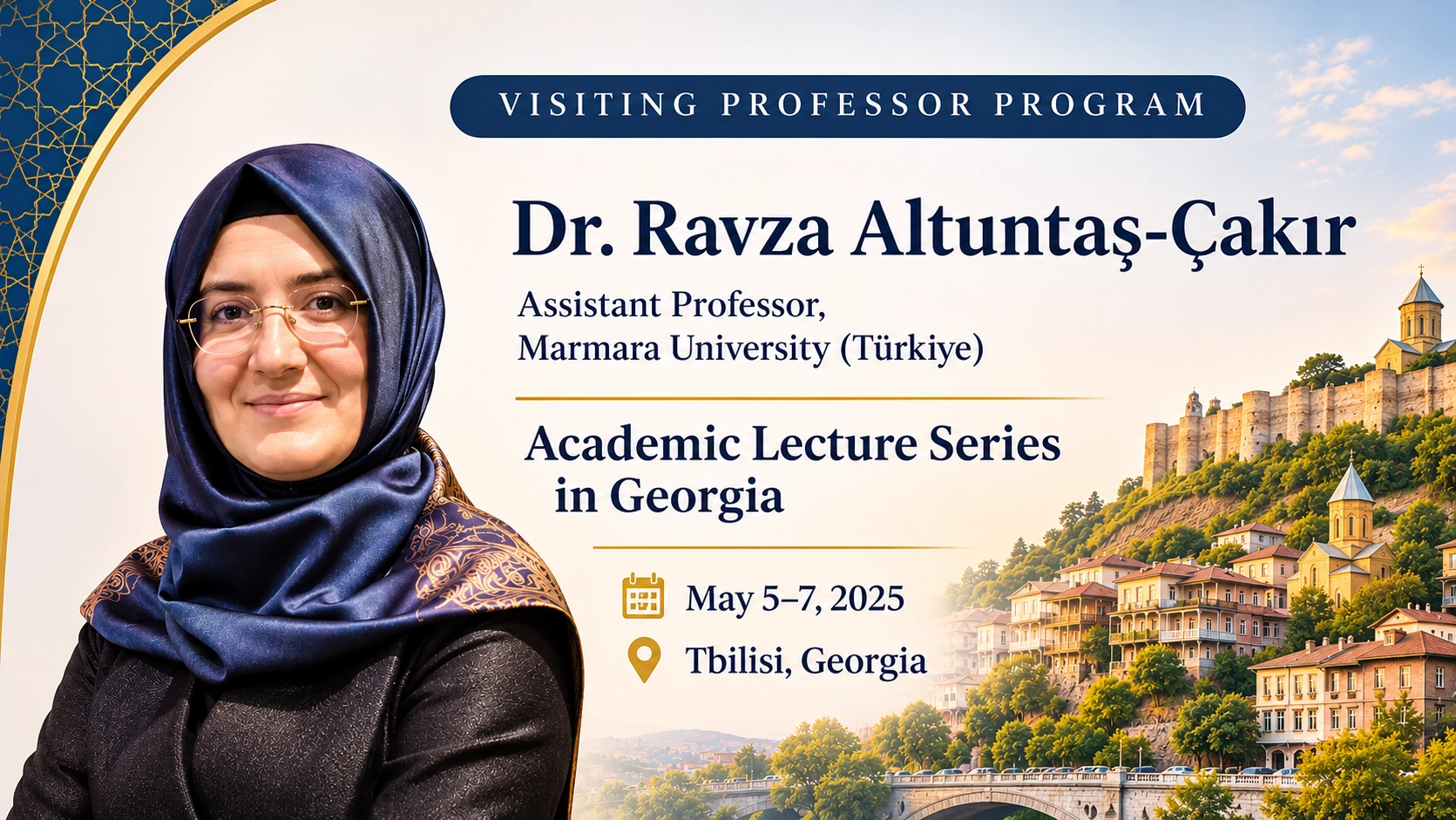
From May 5 to 7, 2025, a series of academic lectures by Dr. Ravza Altuntaş-Çakır, Assistant Professor at Marmara University (Türkiye), took place in Tbilisi, Georgia. The lectures were organized by the Institute of Knowledge Integration (IKI) as part of its international Visiting Professor Program.
The initiative aimed to promote academic cooperation, strengthen interuniversity ties, and expand scholarly dialogue on contemporary issues related to Islamic thought and modern society. Over three days, the visiting scholar delivered four lectures at three higher education institutions in Georgia – Ivane Javakhishvili Tbilisi State University, Caucasus International University, and Ilia State University.
The academic program covered a broad range of topics related to the Islamic intellectual tradition, women's rights, contemporary social transformations, and the interaction between religious heritage and modern understandings of humanity and society. Particular attention was given to different approaches to studying Islamic culture, its underlying values, and its role in the contemporary world.
The first lecture took place on May 5 at Ivane Javakhishvili Tbilisi State University and focused on Islam and women's rights. The session explored different approaches to understanding the position of women within the Islamic tradition, as well as the characteristics of contemporary academic discussions on the subject.
The lecture provided an opportunity to discuss issues related to religious interpretations, cultural perspectives, and societal understandings of women's rights.
According to Dr. Ravza Altuntaş-Çakır, students at Tbilisi State University demonstrated a genuine interest in the topics discussed. Despite certain language barriers arising from varying levels of English proficiency among participants, the meeting reflected the students' willingness to broaden their knowledge and engage in academic dialogue.
On May 6, the program continued at Caucasus International University, where the visiting scholar delivered a lecture entitled “Islam and Women's Rights.”
The discussion focused on the position of women within the Islamic tradition, the diversity of approaches to understanding their rights, and the importance of scholarly dialogue in developing a deeper understanding of these issues.
The lecture generated considerable interest among students and was followed by an active discussion. Participants asked thoughtful questions, shared their perspectives, and demonstrated a strong interest in further exploring the subject.
In her feedback, Dr. Ravza Altuntaş-Çakır particularly highlighted the high level of student engagement at Caucasus International University. In her assessment, this session was the most dynamic and interactive event of the entire visit.
The students' active participation and openness to academic exchange provided a promising foundation for potential future cooperation with the university.
Later that day, on May 6, Dr. Ravza Altuntaş-Çakır delivered a lecture at Ilia State University entitled “Islam and Modernity.”
The lecture addressed the interaction between the Islamic intellectual tradition and contemporary society, as well as different approaches to understanding religious and cultural heritage in the context of ongoing social change.
The audience consisted primarily of members of the university's teaching and research community. According to the visiting scholar, the session was characterized by a high level of academic interest and a substantive exchange of views.
The final lecture took place on May 7, also at Ilia State University. It continued the discussion of Islamic thought and its relationship with contemporary understandings of society.
The session concluded the three-day academic program and provided another opportunity for scholarly exchange between the visiting researcher and members of the university community.
Reflecting on the visit, Dr. Ravza Altuntaş-Çakır positively assessed the meetings and emphasized the importance of continuing academic exchange and open dialogue on issues of interest to researchers, faculty members, and students across the region.
In her feedback, she also highlighted the different forms of engagement observed at the participating universities. At Caucasus International University, student participation was particularly notable; at Ilia State University, discussions were distinguished by the active involvement of faculty members; and at Tbilisi State University, students demonstrated a genuine interest in exploring the topics presented.
These varied forms of academic interaction demonstrated the value of initiatives that bring together representatives of different educational and research institutions to engage with important scholarly questions.
The lecture series in Tbilisi formed part of the international Visiting Professor Program implemented by the Institute of Knowledge Integration to promote academic mobility, strengthen educational and research ties, and expand opportunities for intellectual exchange among scholars and universities from different countries.
The program creates opportunities for visiting researchers to interact directly with students and faculty members at host universities, facilitating the dissemination of scholarly knowledge, encouraging research interests, and fostering lasting academic connections.
Dr. Ravza Altuntaş-Çakır's visit served as a valuable example of international academic cooperation aimed at expanding scholarly dialogue and deepening understanding of the Islamic intellectual tradition. The meetings also highlighted opportunities for further engagement with universities in Georgia and the development of joint academic and educational initiatives.