

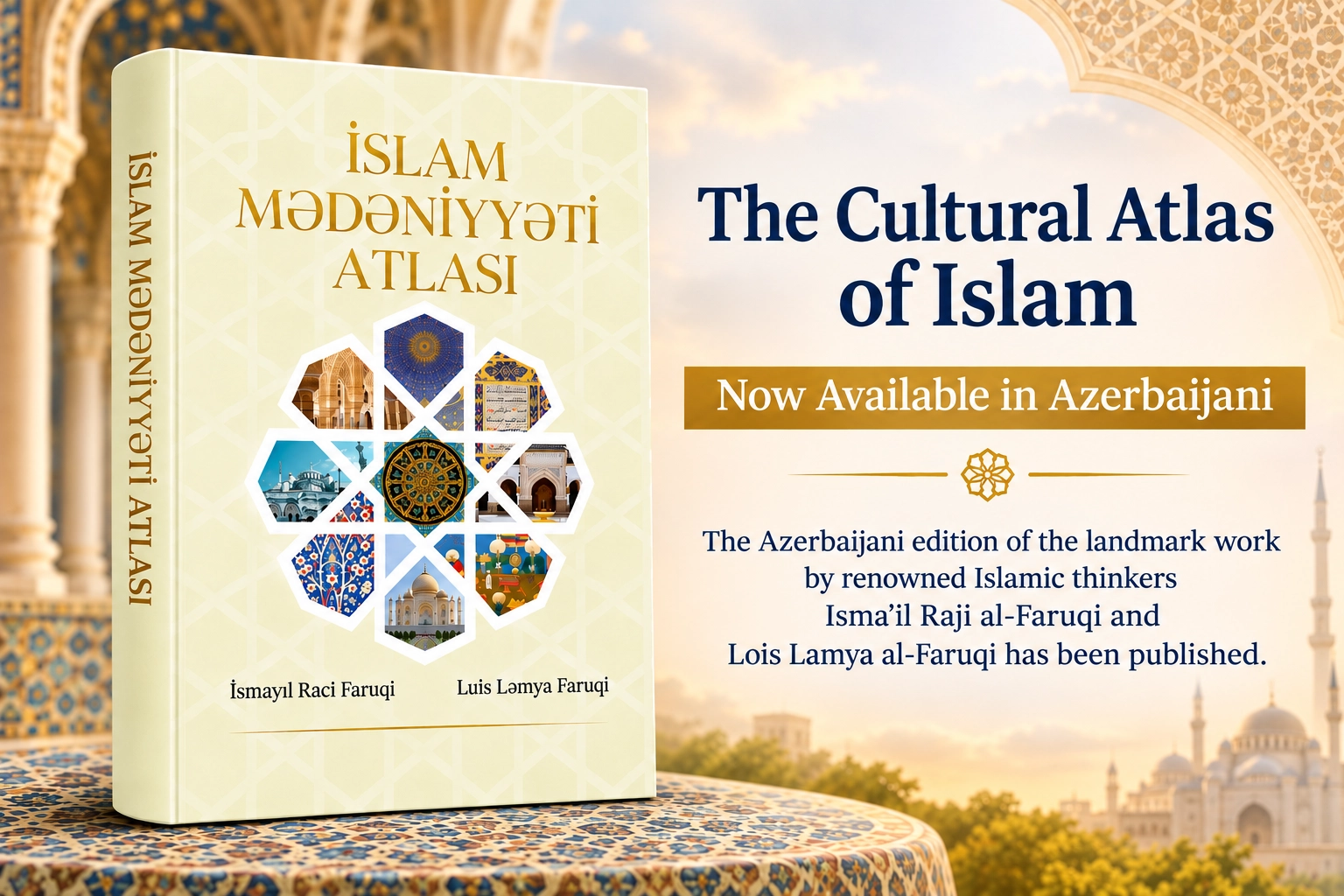
The Azerbaijani edition of The Cultural Atlas of Islam (İslam mədəniyyəti atlası), a fundamental work by renowned Islamic thinkers and scholars Isma'il Raji al-Faruqi and Lois Lamya al-Faruqi, has been published in Azerbaijan. Released in 2026, the book presents a comprehensive study of the history, spiritual foundations, and intellectual heritage of Islamic civilization, highlighting its contributions to the development of world culture, science, and the arts.
The Azerbaijani edition was prepared with the participation of the International Institute of Islamic Thought (IIIT), the Institute of Oriental Studies named after Academician Ziya Bunyadov, and the Idrak Public Union. The scientific editor of the publication is Academician Govhar Bakhshaliyeva. The translation into Azerbaijani, editorial preparation, and scholarly annotations were undertaken by Elvusal Mammadov, PhD in Philosophy.
The original work, The Cultural Atlas of Islam, first published in 1986, occupies a significant place in the intellectual legacy of Isma'il Raji al-Faruqi and Lois Lamya al-Faruqi. The authors offer a comprehensive understanding of Islamic civilization, examining it not only through historical events, political developments, and cultural achievements, but also through the system of worldview principles that shaped the development of Muslim societies over the centuries.
Central to the study is the concept of tawhid – the oneness of God – which the authors regard as the fundamental principle of the Islamic worldview and the unifying foundation of Muslim culture. The book explores how this principle influenced the formation of religious institutions, social relations, scientific thought, aesthetic perspectives, and various forms of creative expression.
One of the distinctive features of The Cultural Atlas of Islam is its interdisciplinary approach. The study encompasses a wide range of subjects, including the historical and cultural origins of Islamic civilization, the development of the Arabic language, the role of the Holy Qur'an and Sunnah, and the emergence of Islamic law, theology, philosophy, and Sufi traditions. Particular attention is devoted to the methodology of scientific inquiry, Qur'anic sciences, Hadith studies, and the intellectual interaction of the Muslim world with the heritage of other civilizations.
A substantial part of the work is dedicated to the artistic heritage of Islamic civilization. The authors examine literature, calligraphy, ornamental art, architecture, and musical traditions in detail, demonstrating the relationship between aesthetic forms and the spiritual and philosophical foundations of Islamic culture.
The publication is distinguished by its rich illustrative material. Historical maps, diagrams, tables, chronological information, photographs of architectural monuments, and works of art enable readers to trace the geographical spread of Islam, the development of cultural centers, and the diversity of artistic traditions throughout the Muslim world. In this way, the book combines in-depth scholarly analysis with a visually accessible presentation of historical and cultural material.
The publication of The Cultural Atlas of Islam in Azerbaijani is particularly significant in expanding access to fundamental studies of Islamic civilization. The translation provides Azerbaijani-speaking readers with an opportunity to engage with one of the most comprehensive works devoted to the systematic study of Islamic cultural heritage in their native language.
The book will be of interest to scholars of Islamic thought, historians, Orientalists, specialists in religious studies and cultural studies, educators, and students, as well as a broader readership seeking a deeper understanding of the intellectual and spiritual foundations of Muslim civilization.
The publication of the Azerbaijani edition continues international efforts to disseminate the scholarly legacy of Isma'il Raji al-Faruqi and Lois Lamya al-Faruqi in different languages. Such publishing initiatives contribute to the development of academic dialogue, the expansion of educational opportunities, and the strengthening of interest in the comprehensive study of Islamic history and culture.
The Cultural Atlas of Islam demonstrates that the heritage of Islamic civilization represents a multifaceted intellectual and cultural tradition in which religious thought, scientific inquiry, social life, and artistic creativity developed in close interaction. The availability of this work in Azerbaijani opens new opportunities for its study and application in educational and research activities.