

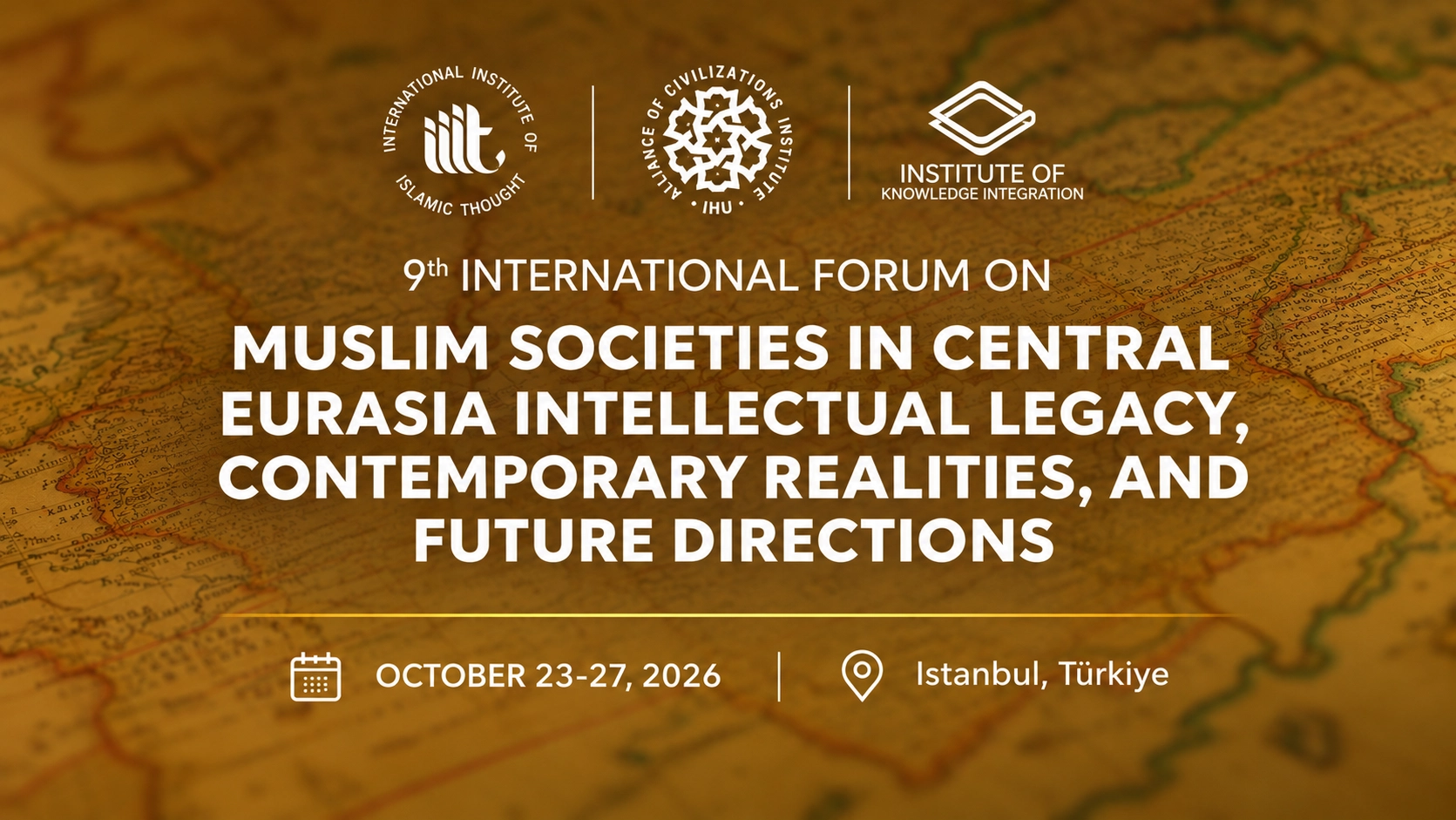
From October 23 to 27, 2026, Istanbul, Türkiye, hosted the 9th International Forum on Muslim Societies in Central Eurasia: Intellectual Legacy, Contemporary Realities, and Future Directions.
The event was jointly organized by the International Institute of Islamic Thought (IIIT), the Alliance of Civilizations Institute (MEDIT) at Ibn Haldun University, and the Institute of Knowledge Integration (IKI). The forum brought together scholars and researchers from various countries whose work focuses on Islamic intellectual traditions, history, education, religious life, and contemporary social developments.
The main academic sessions took place from October 24 to 26 at the historic Süleymaniye Salis Madrasa in Istanbul.
The forum focused on examining the intellectual legacy of Muslim societies in Central Eurasia, analyzing contemporary social and cultural transformations, and discussing future directions for Islamic education, scholarship, and international academic cooperation.
The official opening ceremony was held on October 24 and began with a recitation from the Holy Qur'an.
Welcoming remarks were delivered by Assistant Professor Ercüment Asil, Director of the Alliance of Civilizations Institute (MEDIT) at Ibn Haldun University; Mohammad Tutunji, Member of the Board of Trustees of the International Institute of Islamic Thought; and Gapur Oziev, Managing Director of the Institute of Knowledge Integration.
The keynote address, entitled "Epistemological Renewal as the Basis for Development of Muslim Societies," was delivered by Omar Hasan Kasule, a Member of the IIIT Board of Trustees. The session was chaired by Gapur Oziev, Managing Director of the Institute of Knowledge Integration.
The keynote theme highlighted one of the central directions of the forum's academic program – the need to reconsider approaches to the production, transmission, and integration of knowledge in the context of contemporary societal transformations.
The academic program on the first day focused on the historical legacy of Islamic education, its institutional transformations, and prospects for further development.
The first panel, "Islamic Education in Post-Soviet Central Asia: Historical Legacies, Institutional Transformations, and Future Prospects," was chaired by Vahdettin Işık of Ibn Haldun University.
Uygun Gafurov, Rector of the Tashkent Islamic Institute named after Imam al-Bukhari (Uzbekistan), presented a paper on the history and future prospects of Islamic education in Uzbekistan. Rouslan Jalil of the University of Magdeburg (Germany) examined the development of Islamic higher education in post-Soviet Central Asia in the context of interactions between secular governance and Islamic educational activism.
The discussion continued with a special panel entitled "New Trends in Islamic Intellectual Thought and Education," moderated by Gapur Oziev. The discussants included Dr. Ildus Rafikov, Director of Academic Affairs at the Institute of Knowledge Integration, and Ayaz Asadov of the Alliance of Civilizations Institute at Ibn Haldun University.
The second academic panel, "Knowledge Integration and the Future of Islamic Education in Central Eurasia: Qur'anic Methodology, Futures Thinking, and Knowledge Heritage," was chaired by Ayaz Asadov.
Samuel Avarskiy, representing the Institute of Knowledge Integration, addressed Qur'anic methodology and the prospects for knowledge integration in an era of globalization and economic inequality.
Otabek Pulatov of Uzbekistan presented research on the epistemology of craftsmanship, examining the relationship between knowledge, religious authority, and the transmission of professional skills within Central Asian craft traditions.
Yelena Muzykina of Kazakhstan explored the potential of futures studies as a methodological framework for reimagining Islamic education.
The first day thus covered a broad range of issues, from the historical development of Islamic educational institutions to the search for new methodological approaches capable of connecting intellectual heritage with contemporary academic and societal needs.
On October 25, the forum continued with discussions on spiritual well-being, psychological resilience, Islamic ethics, and the transformation of Muslim communities.
The third panel, "Spirituality, Well-Being, and Youth Resilience in a Globalized World," was chaired by Filius Iakhin, representing the Institute of Knowledge Integration.
Fatmir Shehu, affiliated with the Institute of Knowledge Integration and the International Islamic University Malaysia, presented a paper on the Qur'anic concept of *al-nafs al-mutma'innah* – the tranquil soul – and its ethical relevance in the age of globalization.
Shoirakhon Nurdinova of the Central Asia Program at George Washington University (USA) examined the relationship between religiosity and subjective happiness, drawing on insights from Uzbekistan.
Bukuri Zejno, representing the Institute of Knowledge Integration, discussed the application of fundamental Islamic principles to contemporary challenges faced by Muslim youth.
The fourth panel, "Islamic Spiritual Care and Psychology: Ethical Frameworks, Therapeutic Integration, and the Use of Classical Texts," was chaired by Burcu Uysal of Ibn Haldun University.
Nazila Isgandarova of Canada presented research on Islamic spiritual care and psychotherapy, focusing on the reciprocal ethics of *muraqabah* in contemporary therapeutic practice.
Filius Iakhin examined core emotional needs in schema therapy and their understanding within the Qur'an, addressing an integrative therapeutic approach that takes into account the spiritual and psychological dimensions of human personality.
Zeynep İrem Çeven of Istanbul University discussed the use of classical Islamic texts in psychological practice, with particular attention to questions of interpretation and application.
The fifth panel, "Muslim Communities and al-Maslaha al-Amma in Central-Eastern Europe," was chaired by Dr. Oleg Yarosh, affiliated with the Institute of Knowledge Integration and Friedrich-Alexander University Erlangen-Nuremberg (Germany).
Marek Moroń of Jagiellonian University (Poland) examined the concept of the common good in the six-hundred-year history of Muslims in Polish lands and its future prospects.
Mariusz Marszewski of Poland presented research on the Islamic Foundation for Education and Integration, focusing on its organizational model and relations with the state.
Egdūnas Račius of Vytautas Magnus University (Lithuania) addressed the social integration of Muslim communities in Lithuania and their participation in advancing the common good.
The academic program of the second day concluded with the sixth panel, "Jadidism across Central Eurasia: Intellectual Genealogies, Transregional Encounters, and Modern Identity," chaired by Mustafa Tuna of Duke University (USA).
Shahnoza Madaeva of the National University of Uzbekistan examined the interaction between religion and national identity in the intellectual tradition of the Turkestan Jadids and its transformation within contemporary Uzbek identity.
Enes Özcan, representing the Institute of Knowledge Integration and the Alliance of Civilizations Institute at Ibn Haldun University, addressed paradigm shifts in Islamic political thought, tracing intellectual continuities from Ibrahim Müteferrika to the Eurasian Jadid movement.
Zafar Najmiddinov of Uzbekistan presented research on perceptions of Middle Eastern Muslims through the eyes of a Central Asian Jadid.
The themes of the second day reflected the diversity of research on Muslim societies, ranging from individual spiritual and psychological well-being to historical developments, social institutions, and intellectual movements.
On October 26, the forum's academic program continued with discussions on contemporary interpretations of Islamic concepts, migration, economic well-being, and the formation of Muslim identity.
The seventh panel, "Reframing Islamic Concepts in Contemporary Contexts: Territory, Migration, and Spiritual Belonging," was chaired by Ercüment Asil.
Renat Bekkin of the Institute for African Studies of the Russian Academy of Sciences examined theological interpretations of the concepts of *jihad*, *dar al-Islam*, *dar al-harb*, and related categories in statements by Muslim religious leaders in contemporary Russia.
Adilia Iulgusheva of the University of Granada explored the concept of *ghurba* – estrangement or being away from one's homeland – in contemporary Muslim experience, examining its transformation from social migration into metaphysical wayfaring.
The eighth panel, "Economic Well-Being, Moral Imaginaries, and Muslim Lived Experiences in Central Asia," was chaired by Yaşar Sarı of Ibn Haldun University.
Sharofiddin Ashurov of the International Islamic University Malaysia presented a comparative study of Islamic banking and multidimensional economic well-being in selected Central Asian countries.
Przemyslaw Ozierski of Kyrgyzstan examined the fear of missing out, fraudulent schemes, and moral imaginaries within Central Asian Muslim societies.
Makpal Davletyarova of Kazakhstan addressed media representation and self-identification among Muslim women, drawing on their lived experiences.
The ninth panel, "Negotiating Modernity, Integration, and Diaspora Institution-Building across Eurasia," was chaired by Yelena Muzykina.
Esra Polat of Türkiye examined the ways Muslim societies negotiate processes of modernization, drawing on the Turkish experience.
Seifulla Rashydov and Oleg Yarosh presented research on the institutionalization of the North Caucasian diaspora in Ukraine since 1991.
Guzal Najmiddinova of Bukhara State University (Uzbekistan) discussed contemporary trends in the cultural integration of Turkic peoples in Central Asia.
The presentations on the third day addressed religious identity, cultural belonging, economic relations, and institutional transformations, reflecting the complexity of contemporary developments within Muslim societies across Eurasia.
A special session entitled "IKI Research and Publication Activities – From Forum Papers to an Edited Volume" occupied an important place in the forum's program.
The session featured Elmira Akhmetova, Director of Research and Grants at the Institute of Knowledge Integration, and Ayaz Asadov of the Alliance of Civilizations Institute at Ibn Haldun University.
The session focused on academic publishing activities and the prospects for preparing a collective scholarly volume based on papers presented at the forum.
The inclusion of this topic in the program underscored the importance of academic publications as a means of preserving intellectual heritage, disseminating research findings, and strengthening international academic engagement.
The 9th International Forum provided an important platform for examining a wide range of issues concerning the history, contemporary conditions, and future development of Muslim societies in Central Eurasia.
The academic program brought together research in Islamic education, epistemology, psychology, history, sociology, economics, and religious studies. Particular attention was given to the relationship between intellectual heritage and contemporary scholarly approaches, as well as the potential of knowledge integration in addressing current societal challenges.
Considerable attention was also devoted to preserving and reinterpreting the Islamic intellectual tradition, developing research methodologies, and expanding interdisciplinary academic dialogue.
For the Institute of Knowledge Integration, its involvement in organizing the forum and contributing to its academic program represented an important step toward expanding international cooperation, strengthening research networks, and advancing the concept of knowledge integration.
The diversity of academic perspectives represented at the forum and the participation of researchers from various institutions highlighted the significance of such international gatherings for knowledge exchange, collaborative research, and continued reflection on the intellectual heritage of Muslim societies in the contemporary world.