

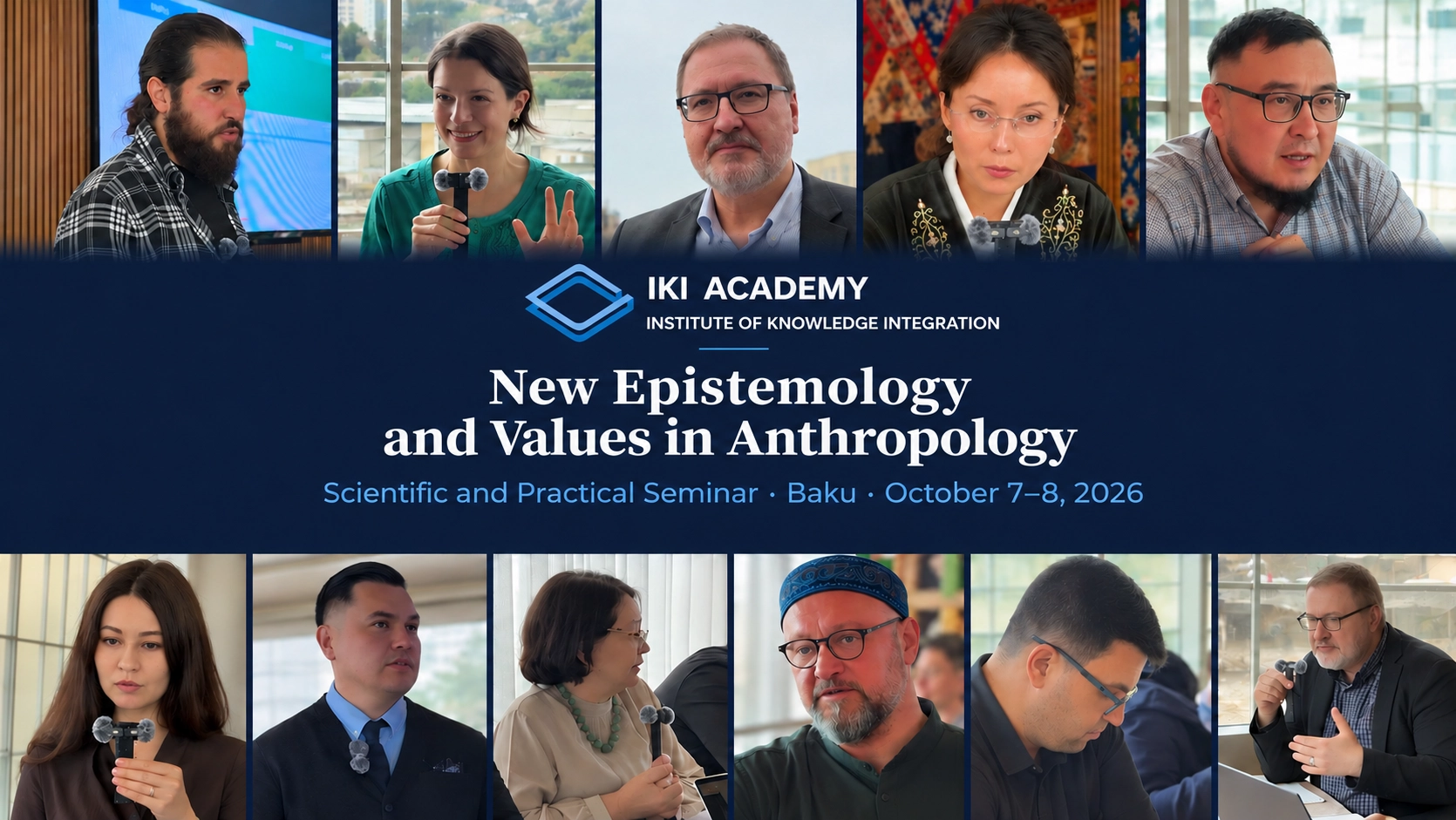
On October 7-8, 2026, the international scientific and practical seminar “New Epistemology and Values in Anthropology” took place in Baku, Azerbaijan, bringing together scholars and researchers from Germany, Belgium, Kazakhstan, Russia, Uzbekistan, and Kyrgyzstan. The event focused on contemporary approaches to the study of human beings, questions of knowledge and epistemology, methodological issues in anthropological research, and the role of religious and ethical values in the production of scientific knowledge.
The seminar aimed to provide a platform for academic dialogue among representatives of different research traditions, explore opportunities for knowledge integration, and identify prospects for international academic cooperation.
The seminar's conceptual framework was based on a holistic understanding of the human being, whose study requires the interaction of approaches drawn from the humanities, social sciences, philosophy, ethics, and religion. Particular attention was given to opportunities for dialogue among Western, Eastern, and Islamic intellectual traditions, as well as to reconsidering the methodological foundations of contemporary anthropology.
The seminar opened with welcoming remarks by Anar Yusifzade, representing the Idrak Public Association (Baku), and Dr. Oleg Yarosh of Friedrich-Alexander University Erlangen–Nuremberg (Germany).
Scientific Presentations: Methodology, Ethics, and Religious Experience
The first day of the seminar, October 7, was devoted to academic presentations organized into three thematic sessions.
The first session, “Epistemology and Methodology,” was chaired by Dr. Ruziya Kamarova of Astana IT University (Kazakhstan). It focused on the study of religious experience, the particularities of anthropological fieldwork, and the interpretation of sacred space.
Adilya Yulgusheva, a doctoral student at the University of Granada, presented a paper on the verbalization of the religious experience of listening to the adhan (Islamic call to prayer). Dr. Lili di Puppo of the Catholic University of Louvain (Belgium) addressed the particularities of conducting field research on Sufism, while Dr. Igor Pankov of the Institute of Oriental Manuscripts of the Russian Academy of Sciences (St. Petersburg) explored the hidden life of sacred space.
The second session, “Ethical and Applied Aspects of Research,” was chaired by Dr. Ulan Bigozhin of Nazarbayev University (Kazakhstan). The presentations addressed the position of anthropologists within the religious communities they study, methodological challenges in digital ethnography, and the significance of Islamic ethics in academic research.
Erik Seitov, an independent researcher from Uzbekistan, examined the particularities of anthropological fieldwork in post-Soviet Shia communities, drawing on examples from Moscow, Derbent, and Bukhara. Dr. Akif Tagiyev of Goethe University Frankfurt (Germany) presented a paper on the methodological and ethical challenges of studying Islam in digital environments. Dr. Oleg Yarosh focused on the principle of reciprocity and Islamic ethics in ethnographic research.
The third session, “Forms of Islamic Life in Central Asia,” was chaired by Dr. Nestor Manechkin, an independent researcher from Kyrgyzstan.
Dr. Ruziya Kamarova presented research on sacred geography and the interaction between Islam and local traditions in Kazakhstan. Dr. Aigerim Temirbayeva of the Egyptian University of Islamic Culture Nur-Mubarak (Almaty) addressed gender dimensions of Sufi practices and female agency within a value-oriented integrative approach. Dr. Ulan Bigozhin examined religious life in late Soviet Kazakhstan through a study dedicated to Khoja Imam Faizulla.
The presentations demonstrated the diversity of research approaches to Islam and religious life, highlighting the importance of considering specific historical, social, and cultural contexts.
Day Two: Academic Discussions and New Approaches to Understanding Human Beings
On October 8, the seminar continued with moderated discussions that allowed participants to explore theoretical and methodological questions in contemporary anthropology in greater depth.
The first discussion, moderated by Dr. Aigerim Temirbayeva, addressed the position of researchers within the communities they study, the relationship between insider and outsider perspectives, the experiences of Muslim women researchers working within religious environments, and the formation of sacred geography under the influence of religious, national, and socioeconomic factors.
The second discussion, moderated by Dr. Nestor Manechkin, focused on post-secular anthropology and the possibilities of incorporating religious categories into contemporary academic discourse.
Particular attention was devoted to concepts such as the “soul,” “heart,” “eternity,” and “afterlife,” and their significance for understanding human beings within different intellectual and religious traditions. Participants explored the ontological turn in anthropology, Islamic epistemology, and possible points of convergence between these approaches.
Autobiographical and autoethnographic approaches also received considerable attention, particularly their potential to treat researchers' personal experiences as sources of scholarly insight into religious life. The discussions addressed both the possibilities and limitations of these methods, as well as questions of academic objectivity, research responsibility, and ethics.
The discussions highlighted the relevance of developing methodological approaches capable of considering not only the external social manifestations of religion but also believers' inner experiences, worldviews, and value systems.
Prospects for Academic Cooperation
An important part of the seminar was devoted to discussing future opportunities for international academic cooperation.
One of the main areas of future work involved preparing a collective scholarly publication intended to bring together participants' research contributions and the outcomes of the seminar discussions. The planned volume aims to present diverse approaches to questions of anthropology, epistemology, religious experience, and knowledge integration.
Participants also discussed opportunities to continue academic dialogue, exchange research experience, and develop joint scholarly projects. Particular attention was given to prospects for interdisciplinary cooperation among specialists studying religion, human beings, and society from different academic and intellectual perspectives.
Knowledge Integration as a Foundation for Interdisciplinary Dialogue
The seminar in Baku provided a platform for addressing fundamental questions in contemporary humanities and social sciences: how different scientific and religious traditions understand human beings, how research methods relate to value systems, and what opportunities interdisciplinary approaches can offer.
The significance of the event lay in its effort to connect empirical anthropological research with broader philosophical and epistemological reflections on human beings, their religious experiences, and their place in society.
For the Institute of Knowledge Integration, the seminar marked an important step in strengthening international academic cooperation and advancing an approach based on interaction among different fields of knowledge.
The research directions explored and the initiatives discussed during the seminar provide a foundation for continued collaboration, future scholarly publications, and the further development of international academic dialogue.